
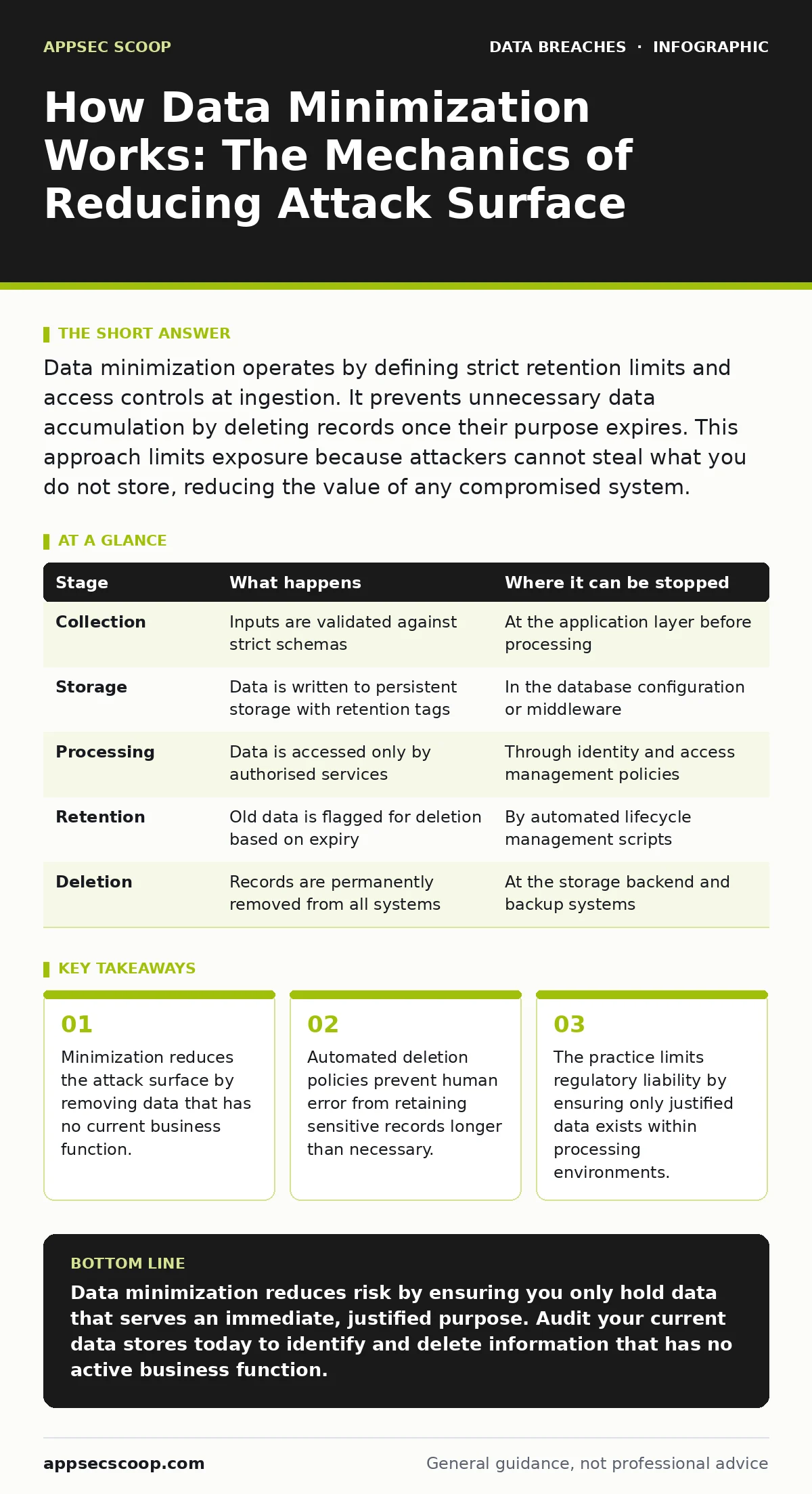
Data minimization operates by defining strict retention limits and access controls at ingestion. It prevents unnecessary data accumulation by deleting records once their purpose expires. This approach limits exposure because attackers cannot steal what you do not store, reducing the value of any compromised system.
The Principle of Least Data
Data minimization is the practice of limiting personal data collection to what is strictly necessary for a specified purpose. It is not merely a privacy preference but a security control. When you store less data, you reduce the value of your systems to attackers. A database containing only transaction IDs and hashes offers little utility compared to one holding full names, addresses, and payment details. The mechanism relies on defining the minimum viable dataset for each process and enforcing strict boundaries around it.
This approach shifts security from perimeter defence to data-centric protection. Traditional security assumes that if you protect the network, the data inside is safe. Minimization argues that even if the network is breached, the data inside is not worth stealing. This changes the attacker’s cost-benefit analysis. They must expend more effort for less reward. The principle applies to every stage of the data lifecycle, from collection to deletion.
Stage 1: Collection and Intake
The first stage occurs at the point of entry. Systems must validate incoming data against a predefined schema. Any field that does not serve a direct operational purpose is rejected or discarded immediately. This prevents accidental accumulation of redundant information. For example, a login form should request only a username and password, not a date of birth or phone number, unless those are explicitly required for multi-factor authentication.
Behind the scenes, the application logic checks each input field against a whitelist of permitted attributes. If a user submits extra data, the system ignores it. This requires careful design during the development phase. Developers must document why each field is needed. Without this documentation, teams tend to collect everything "just in case," which defeats the purpose of minimization.
| Stage | What happens | Where it can be stopped |
|---|---|---|
| Collection | Inputs are validated against strict schemas | At the application layer before processing |
| Storage | Data is written to persistent storage with retention tags | In the database configuration or middleware |
| Processing | Data is accessed only by authorised services | Through identity and access management policies |
| Retention | Old data is flagged for deletion based on expiry | By automated lifecycle management scripts |
| Deletion | Records are permanently removed from all systems | At the storage backend and backup systems |
The Mechanics of Storage and Access
Once data passes intake, it enters storage. Minimization dictates that data should not be stored in plain text if it can be avoided. While encryption in transit protects data moving between systems, data at rest requires different controls. The system should apply tokenisation or hashing where possible. This replaces sensitive values with non-sensitive equivalents. A credit card number becomes a random token that has no mathematical relationship to the original value.
Access controls must be granular. Services should only access the specific fields they need. A billing service does not need to read a user’s profile biography. By segmenting data access, you limit the blast radius of a compromised service account. If an attacker gains access to the billing system, they cannot pivot to view personal messages or identification documents.
This stage often reveals hidden costs. Implementing strict access controls requires more complex architecture. You need separate databases or tables for different data types. This increases engineering overhead. However, the trade-off is significant. It prevents lateral movement by attackers who have breached one component of your infrastructure.
Stage 2: Processing and Usage
During processing, data is actively used by applications. Minimization requires that data be used only for the purpose for which it was collected. If a user provided their address for shipping, that address should not be used for marketing analytics without explicit consent. The system must enforce these boundaries programmatically.
Behind the scenes, this involves tagging data with purpose codes. When an application requests data, it must declare its intent. The database checks this intent against the data’s tags. If the intents do not match, the request is denied. This prevents data drift, where information collected for one purpose is gradually used for others. It also simplifies compliance audits, as the usage history is clear and enforceable.
Limits and Edge Cases
Data minimization is not a silver bullet. It has practical limits. Some processes legally require retaining data for long periods. Financial records, for instance, must be kept for tax purposes. In these cases, you cannot delete the data. Instead, you must apply data masking or restrict access to a minimal number of authorised personnel. The goal shifts from deletion to strict isolation.
Another limit is the conflict with machine learning initiatives. AI models often require large datasets to train effectively. Minimizing data can degrade model accuracy. You must balance security with functionality. Techniques like differential privacy allow you to train models on aggregated data without exposing individual records. This maintains utility while preserving minimization principles.
Stage 3: Retention and Archival
Retention policies define how long data stays in active systems. Minimization requires setting explicit expiry dates for every data type. Once the expiry date passes, the data moves to archival or is deleted. Active systems should never contain stale data. Stale data is data that has no current business value but remains accessible to attackers.
Behind the scenes, cron jobs or scheduled tasks scan databases for expired records. They move these records to cold storage or delete them. Cold storage is cheaper and less accessible, reducing the risk of accidental exposure. However, cold storage must also be protected. Attackers often target backups because they are less monitored. Ensure that archival systems have equivalent security controls to active systems.
The Final Stage: Deletion
Deletion is the most critical stage. Many organisations fail here. They delete data from the primary database but leave it in backups, logs, or shadow databases. True minimization requires erasure from all locations. This includes database snapshots, search indexes, and analytics warehouses.
Imagine a scenario where a user requests account deletion. The application removes the user profile from the main database. However, the analytics pipeline still contains their behaviour data from the past year. If the analytics database is breached, the user’s data is exposed despite the deletion request. To prevent this, deletion requests must propagate to all downstream systems. This requires robust data lineage tracking.
Stage 4: Erasure and Verification
The final step is verifying that deletion was successful. You cannot trust that a delete command worked without confirmation. Systems should generate audit logs confirming the removal of data. These logs should be immutable and stored securely. They provide evidence that minimization policies are being followed.
Verification also involves checking for residual data in temporary files or cache. Caches often store copies of data for performance reasons. If these are not cleared, the data persists. Automated scripts should purge caches and temporary directories regularly. This ensures that no fragments of deleted data remain accessible.
See also: Data sovereignty definition: controlling where your data lives and obeys · Difference Between Data Breach and Data Exfiltration: The Operational Truth
Integration with Other Controls
Data minimization works best when combined with other security measures. It complements database security by reducing the number of records that need protection. It supports data sovereignty by keeping data within required geographical boundaries, as less data means fewer storage locations. When paired with encryption in transit, it ensures that even if data is intercepted, it is limited in scope.
Consider the impact on breach dwell time. If an attacker breaches your system, they spend time searching for valuable data. If you have minimized your data stores, they find little of value quickly. This may cause them to leave sooner, reducing the overall impact. While minimization does not prevent the initial breach, it mitigates the consequences.
Related practices like data masking can be used alongside minimization. Masking hides specific details while retaining the structure of the data. This is useful for testing environments where real data is needed but privacy must be preserved. PCI DSS requirements often align with minimization, as cardholder data should not be stored unless absolutely necessary. Understanding data breach costs helps justify the investment in minimization, as the cost of implementation is often lower than the cost of a single incident.
Key takeaways
- Minimization reduces the attack surface by removing data that has no current business function.
- Automated deletion policies prevent human error from retaining sensitive records longer than necessary.
- The practice limits regulatory liability by ensuring only justified data exists within processing environments.
Data minimization reduces risk by ensuring you only hold data that serves an immediate, justified purpose. Audit your current data stores today to identify and delete information that has no active business function.
Frequently asked questions
Does data minimization prevent data breaches?
No, minimization does not prevent unauthorized access to your systems. It reduces the impact of a breach by ensuring there is less valuable data to steal.
Can I apply minimization to historical data?
Yes, you can review historical data and delete records that are no longer needed for legal or business purposes. Ensure you check retention laws before deleting.
How does minimization affect analytics?
Minimization may limit the granularity of analytics. You should use aggregated or anonymized data for analysis to maintain insights without storing personal details.
Is minimization required by law?
Many privacy regulations, such as GDPR, explicitly require data minimization. Failing to implement it can result in significant legal penalties and compliance failures.
How this guide was produced: written by the AppSec Scoop editorial team with AI assistance, checked against the public references listed below, and reviewed when the facts change. See our editorial policy or report an error.