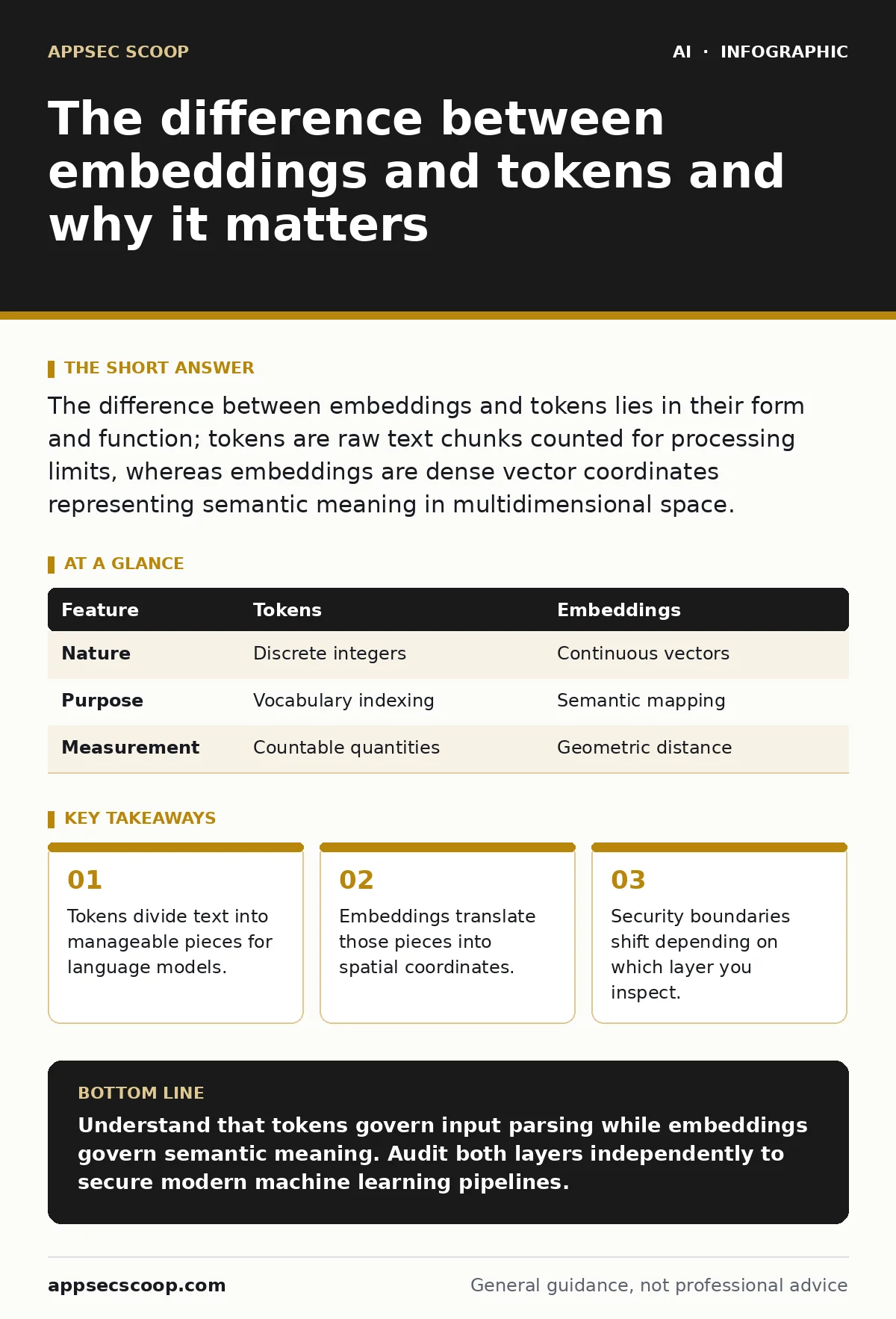
The difference between embeddings and tokens lies in their form and function; tokens are raw text chunks counted for processing limits, whereas embeddings are dense vector coordinates representing semantic meaning in multidimensional space.
What is the difference between embeddings and tokens in machine learning?
The difference between embeddings and tokens centres on representation, where tokens are discrete identifiers and embeddings are continuous mathematical coordinates. Tokens serve as the fundamental alphabet that models parse, slicing sentences into sub-word fractions. Embeddings transform those discrete fractions into multi-dimensional numerical arrays. Security architectures must treat both layers differently because an input vulnerability at the token level manifests as a spatial anomaly in the vector space.
How do tokens function as the atomic units of text processing?
Tokens represent the indivisible building blocks of text that neural networks ingest and manipulate during execution. Language models convert raw characters into integer IDs referencing a fixed vocabulary table. Vocabulary design dictates how efficiently text translates into numeric inputs, affecting both memory consumption and execution speed. Parsing anomalies occur when unusual character combinations fragment unexpectedly, bypassing safety filters designed for standard word boundaries.
Why do embeddings represent meaning through geometric distance?
Embeddings capture semantic relationships by placing concepts close to one another inside a high-dimensional geometric space. Spatial proximity reflects conceptual similarity, allowing algorithms to retrieve related documents without relying on exact keyword matches. Mathematical operations on these vectors manipulate core concepts directly. Distance calculations replace traditional string matching, which introduces distinct privacy vulnerabilities regarding how closely sensitive concepts sit next to public data points.
| Feature | Tokens | Embeddings |
|---|---|---|
| Nature | Discrete integers | Continuous vectors |
| Purpose | Vocabulary indexing | Semantic mapping |
| Measurement | Countable quantities | Geometric distance |
What happens when token boundaries conflict with embedding boundaries?
Token boundaries conflict with embedding boundaries whenever multi-lingual text or obfuscated characters force unexpected vocabulary fragmentation. Attackers exploit this mismatch by inserting invisible characters that alter token counts without changing the visible semantic output. Changing a single token can shift an entire document vector across a decision boundary, bypassing classifiers used in AI risk management frameworks.
How do attackers exploit the translation from tokens to embeddings?
Attackers exploit the translation phase by crafting inputs that maximize geometric distance from known malicious clusters while retaining harmful intent. Subtle perturbations at the token level compound into massive vector shifts, creating adversarial examples that fool similarity-based access controls. Defending against this manipulation requires inspecting input payloads before vectorisation occurs, treating AI models as untrusted insiders that might misinterpret spatial proximity.
See also: Workplace AI usage policies: 5 common traps and how to avoid them · Prompt injection attacks prevention checklist for secure systems
Where do security teams monitor token consumption versus vector spaces?
Security teams monitor token consumption at the API gateway and vector spaces inside dedicated similarity databases. Token monitoring prevents resource exhaustion attacks and tracks user intent through volume anomalies. Vector monitoring detects unauthorized data extraction and clustering attacks that attempt to reconstruct training data leakage vulnerabilities from stored embeddings.
Why is vector database security distinct from prompt filtering?
Vector database security operates on spatial access controls, whereas prompt filtering evaluates sequential text strings for policy violations. Securing vector stores requires enforcing metadata filters and limiting similarity search results to prevent unauthorized data aggregation. Traditional firewalls fail here because malicious payloads do not look like malicious text once converted into floating-point numbers. Proper governance requires integrating these controls into broader AI usage policies at work.
What metrics reveal anomalous embedding behavior in production?
Metrics revealing anomalous embedding behaviour include sudden spikes in nearest-neighbour distance and unusual clustering densities within the vector space. Normal user traffic generates predictable geometric distributions around established operational centroids. Shifting cluster centers often indicate automated probing or injection attempts designed to map decision boundaries.
Key takeaways
- Tokens divide text into manageable pieces for language models.
- Embeddings translate those pieces into spatial coordinates.
- Security boundaries shift depending on which layer you inspect.
Understand that tokens govern input parsing while embeddings govern semantic meaning. Audit both layers independently to secure modern machine learning pipelines.
Frequently asked questions
Can an embedding be reversed back into the original token text?
Reversing embeddings is computationally difficult, but optimization attacks can approximate the original text with high fidelity under specific conditions.
Do all tokens generate the same number of embedding dimensions?
Output dimensions remain fixed for a given model architecture regardless of how many input tokens you process.
Why do security tools struggle to inspect embeddings directly?
Floating-point arrays lack human-readable syntax, making malicious intent invisible to standard pattern-matching security rules.
Are embeddings stored permanently in vector databases?
Systems persist embeddings to enable fast retrieval, creating secondary storage targets that require independent encryption and access control.
How this guide was produced: written by the AppSec Scoop editorial team with AI assistance, checked against the public references listed below, and reviewed when the facts change. See our editorial policy or report an error.