
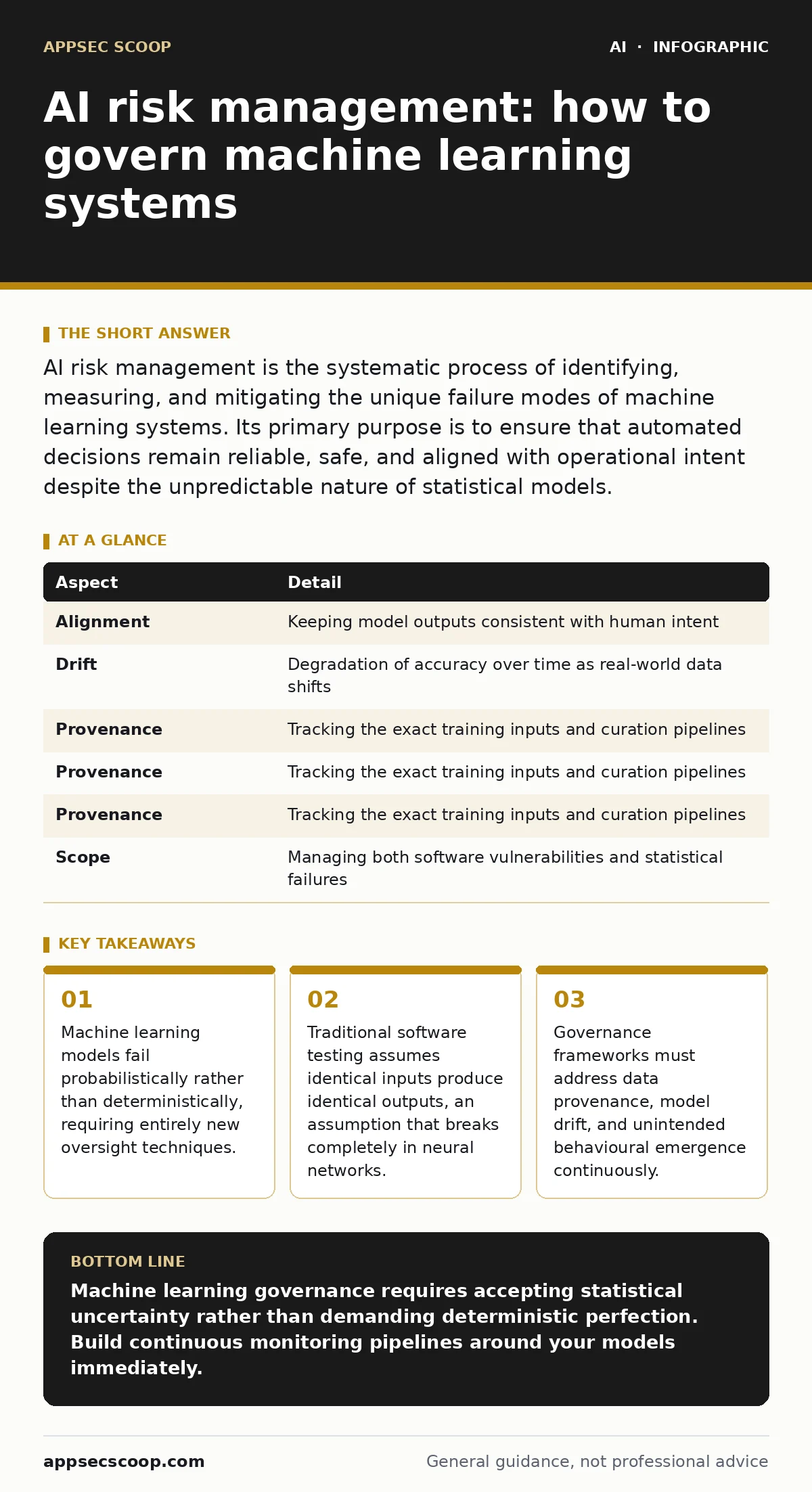
AI risk management is the systematic process of identifying, measuring, and mitigating the unique failure modes of machine learning systems. Its primary purpose is to ensure that automated decisions remain reliable, safe, and aligned with operational intent despite the unpredictable nature of statistical models.
Understanding AI risk management through an everyday analogy
Machine learning governance resembles training a guard dog rather than programming a burglar alarm. A traditional software routine acts like a deadbolt, functioning identically every single time until mechanical failure occurs. An algorithmic model acts like a living animal, possessing immense capability but interpreting commands through statistical correlation rather than logical comprehension.
You cannot inspect every single synapse of a complex neural network to verify its reasoning. Instead, you establish behavioral boundaries, constant supervision, and structured testing routines. This shift from deterministic rules to probabilistic outcomes forms the foundation of modern technical governance.
| Aspect | Detail |
|---|---|
| Alignment | Keeping model outputs consistent with human intent |
| Drift | Degradation of accuracy over time as real-world data shifts |
| Provenance | Tracking the exact training inputs and curation pipelines |
| Provenance | Tracking the exact training inputs and curation pipelines |
| Provenance | Tracking the exact training inputs and curation pipelines |
| Scope | Managing both software vulnerabilities and statistical failures |
What is AI risk management and what problem does it solve?
Artificial intelligence risk management is the structured discipline of controlling the operational hazards introduced by statistical models. Software engineers traditionally spend decades eliminating ambiguity from codebases through strict syntax and deterministic logic. Machine learning completely inverts this paradigm by intentionally introducing statistical inference and pattern recognition to handle ambiguous tasks.
The core problem this solves is the invisible gap between what an engineer intended a model to learn and what the optimization algorithm actually computed. Unchecked models optimize for mathematical shortcuts rather than genuine understanding, leading to catastrophic edge-case failures in production environments.
The main structural components of a governance framework
Effective oversight requires 4 distinct pillars spanning the lifecycle of a machine learning deployment. Data governance ensures training sets lack toxic correlations, unverified scraping artifacts, and copyright violations before training begins. Model validation tests the statistical robustness of the algorithm against edge cases, boundary conditions, and adversarial examples designed to trigger misclassification. Operational monitoring tracks live inference streams to detect sudden drops in accuracy or shifts in input distributions. Finally, human-by-design checkpoints ensure high-stakes decisions retain mandatory operator review before final execution takes place.
Where machine learning governance fits alongside traditional defences
Traditional security tooling focuses on perimeter defense, memory safety, and access control lists to prevent unauthorized code execution. Machine learning systems introduce entirely new attack surfaces that bypass network firewalls entirely because the malicious payload travels through normal data channels.
A properly secured infrastructure can still suffer complete compromise if an attacker exploits prompt injection attacks or manipulates the underlying retrieval-augmented generation security pipelines. Governance acts as an overarching umbrella that coordinates traditional identity management with statistical output verification. You must integrate these controls alongside existing vulnerability management programs without assuming standard application firewalls will catch algorithmic anomalies.
Hidden costs and non-obvious consequences of oversight
Implementing strict oversight introduces significant computational overhead and latency penalties during live model inference. Every validation check, input sanitization routine, and confidence score calculation adds milliseconds of delay to user-facing applications. Furthermore, excessive filtering can create brittle systems that refuse to answer legitimate queries because they trigger false positives within safety classifiers.
Engineers often discover that making a model safer against one specific failure mode makes it noticeably less useful for creative or nuanced tasks. Balancing operational utility against safety constraints requires continuous negotiation between security teams and product developers.
Where traditional software testing fails for statistical models
Conventional software testing relies on binary pass-or-fail assertions based on known inputs and expected outputs. Machine learning models possess infinite potential input combinations, rendering exhaustive input testing mathematically impossible. A traditional function either calculates a square root correctly or crashes, whereas a neural network provides a gradient of confidence scores that fluctuates based on subtle noise.
When reviewing AI usage policies at work, organizations frequently rely on outdated compliance checklists designed for static databases rather than dynamic inference engines. You must accept that absolute certainty is unattainable in probabilistic systems, shifting the goal from bug elimination to continuous behavioral containment.
Key takeaways
- Machine learning models fail probabilistically rather than deterministically, requiring entirely new oversight techniques.
- Traditional software testing assumes identical inputs produce identical outputs, an assumption that breaks completely in neural networks.
- Governance frameworks must address data provenance, model drift, and unintended behavioural emergence continuously.
Machine learning governance requires accepting statistical uncertainty rather than demanding deterministic perfection. Build continuous monitoring pipelines around your models immediately.
Frequently asked questions
How does machine learning risk differ from standard software vulnerability management?
Standard vulnerability management focuses on coding bugs and memory corruption, whereas machine learning risk addresses statistical bias, unpredictable outputs, and data poisoning.
Can automated tools completely replace human oversight in algorithmic governance?
Automated tools can catch known failure patterns, but human review remains essential for evaluating nuanced context, ethical alignment, and novel edge cases.
Why do models degrade in production over time?
Models degrade because real-world data distributions drift away from the historical data patterns the system was originally trained on.
What is the biggest mistake organizations make when deploying machine learning?
Organizations often treat machine learning models like standard static software libraries instead of dynamic entities that require continuous behavioral supervision.
How this guide was produced: written by the AppSec Scoop editorial team with AI assistance, checked against the public references listed below, and reviewed when the facts change. See our editorial policy or report an error.