
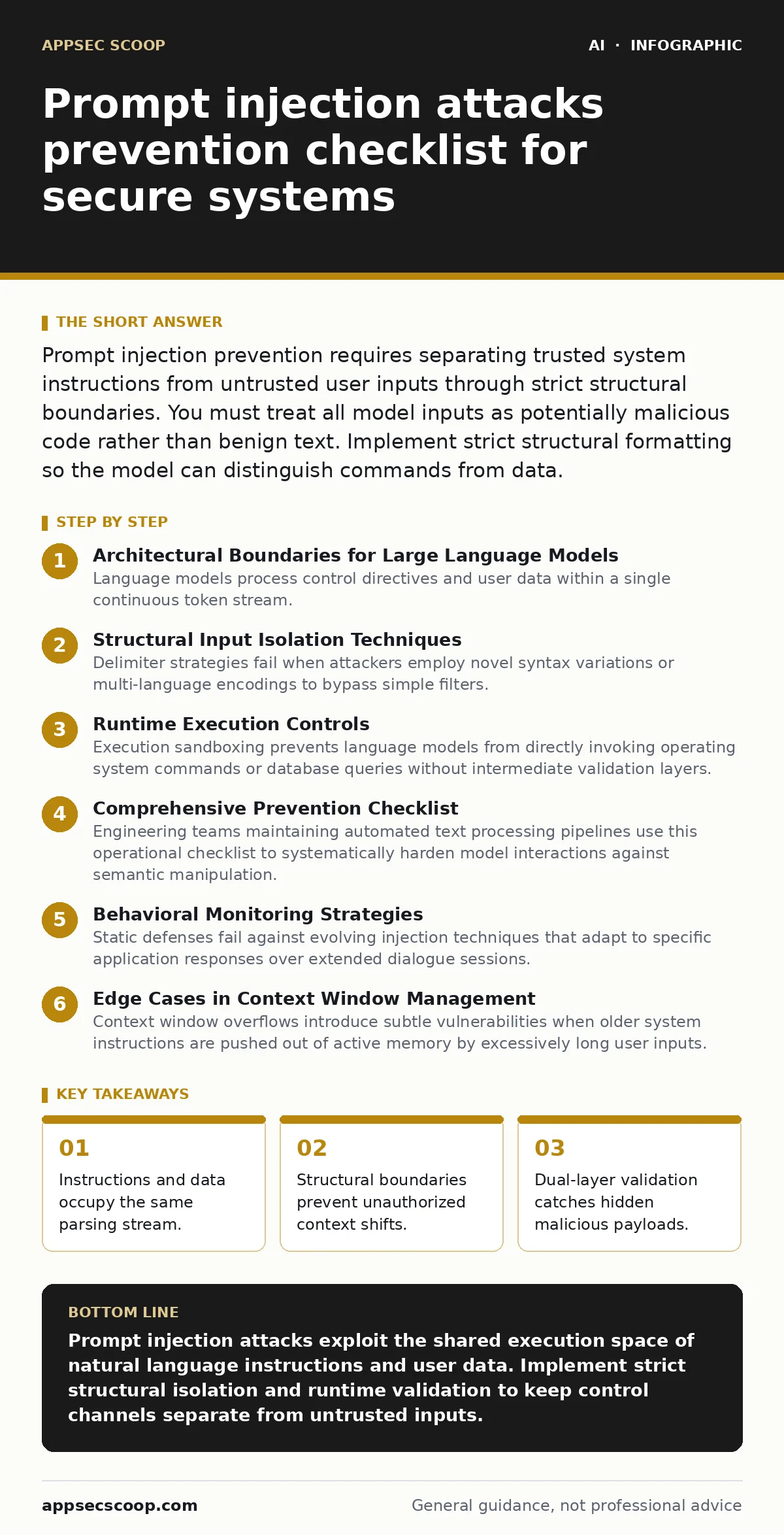
Prompt injection prevention requires separating trusted system instructions from untrusted user inputs through strict structural boundaries. You must treat all model inputs as potentially malicious code rather than benign text. Implement strict structural formatting so the model can distinguish commands from data.
Architectural Boundaries for Large Language Models
Language models process control directives and user data within a single continuous token stream. This unified processing model enables users to manipulate underlying system behaviors by appending conflicting commands to standard queries. Effective defense begins long before runtime by defining rigid boundaries between developer instructions and user content.
Developers often overlook how tokenization merges distinct semantic inputs into a flat array. Imagine a customer support system receiving a translated text string that contains hidden system overrides. The parsing engine treats the override with identical weight to the original developer prompt. Establishing robust internal controls demands foundational frameworks similar to those outlined in AI governance initiatives.
Structural Input Isolation Techniques
Delimiter strategies fail when attackers employ novel syntax variations or multi-language encodings to bypass simple filters. Robust architectures rely on structural isolation where user input populates strictly defined JSON fields or external database parameters rather than raw prompt strings.
Serialization transforms fluid natural language into predictable data structures that downstream parsers handle safely. Unsanitised text streams frequently invite secondary payloads designed to trigger unauthorized function calls. Organizations must establish clear boundaries akin to those detailed in AI usage policies at work to ensure user inputs never alter core system logic.
Runtime Execution Controls
Execution sandboxing prevents language models from directly invoking operating system commands or database queries without intermediate validation layers. Autonomous systems executing multi-step tasks face severe risks when exposed to untrusted instructions embedded inside retrieved documents or web pages.
Preventing unauthorized tool invocation requires strict capability restrictions on external function calling APIs. Malicious instructions frequently attempt to redirect agent workflows toward unintended destinations, mirroring the complex threat vectors analyzed during reviews of AI agent hijacking.
Comprehensive Prevention Checklist
Engineering teams maintaining automated text processing pipelines use this operational checklist to systematically harden model interactions against semantic manipulation. Apply these 3 distinct groupings sequentially across your development lifecycle to verify that control channels remain entirely separate from data ingestion streams.
Input Sanitisation and Structuring
- enforce strict JSON schemas for all incoming user payloads: prevents free-form text strings from masquerading as system instructions
- apply delimiter token randomization per session: stops attackers from predicting fixed boundary markers
- strip control characters and markdown formatting from raw inputs: eliminates common obfuscation vectors used by malicious payloads
Execution and Control Isolation
- restrict model tool invocation permissions to read-only actions: stops unauthorized data modification or exfiltration
- implement dual-model validation pipelines for critical outputs: ensures a secondary independent verifier checks the primary response
- log all raw prompt and completion pairs to isolated storage: provides forensic visibility without exposing sensitive operational logs
Output Verification and Filtering
- scan completion tokens for sensitive system prompt leaks: detects unauthorized disclosure of underlying instructions
- validate response syntax against expected output formats: catches semantic drift before content reaches downstream users
- restrict outbound network calls from model runtimes: blocks direct data exfiltration attempts triggered by injected instructions
Behavioral Monitoring Strategies
Static defenses fail against evolving injection techniques that adapt to specific application responses over extended dialogue sessions. Continuous behavioral auditing detects anomalous prompt patterns by measuring semantic divergence between normal user interactions and suspicious command injections.
Security teams analyze token entropy and unusual parameter shifts to identify automated probing attempts. Monitoring runtime telemetry requires specialized tooling comparable to traditional application performance monitoring solutions, ensuring visibility remains high without degrading response latency.
See also: Workplace AI usage policies: 5 common traps and how to avoid them · The difference between embeddings and tokens and why it matters
Edge Cases in Context Window Management
Context window overflows introduce subtle vulnerabilities when older system instructions are pushed out of active memory by excessively long user inputs. Attackers exploit this memory decay by padding requests with garbage tokens until foundational security prompts vanish from the active attention mechanism.
Fixing this memory vulnerability requires hard limits on input lengths and pinned system prompts that persist regardless of user payload size. Ignoring this architectural detail leaves systems exposed to state exhaustion attacks that silently disable initial safety guardrails.
Key takeaways
- Instructions and data occupy the same parsing stream.
- Structural boundaries prevent unauthorized context shifts.
- Dual-layer validation catches hidden malicious payloads.
Prompt injection attacks exploit the shared execution space of natural language instructions and user data. Implement strict structural isolation and runtime validation to keep control channels separate from untrusted inputs.
Frequently asked questions
What makes prompt injection different from traditional code injection?
Traditional injection relies on distinct syntax rules for code and data, whereas language models process instructions and data within the same natural language parsing stream.
Can regex filters completely stop prompt injection?
Regular expressions fail because natural language offers infinite semantic variations and multilingual encodings that bypass static pattern matching.
Why do system prompts disappear during long conversations?
Active memory constraints force older tokens out of the attention window when user inputs exceed maximum token length limits.
How do dual-model validation pipelines work?
A secondary, isolated model evaluates the primary model response for malicious intent or policy violations before returning output to the user.
How this guide was produced: written by the AppSec Scoop editorial team with AI assistance, checked against the public references listed below, and reviewed when the facts change. See our editorial policy or report an error.