
Workplace artificial intelligence policies often fail because they treat software as a static tool rather than an evolving reasoning system. Effective governance requires understanding data retention, memory persistence, and the subtle mechanics of prompt injection attacks across corporate networks.
Misreading: Pasting internal code into an enterprise chat window is safe because the vendor promises no training
Correct reading: Enterprise service agreements frequently exempt telemetry, error logs, and transient caching layers from zero-retention guarantees. Employees assume that opting out of model training protects intellectual property entirely, ignoring how third-party infrastructure stores intermediate conversation states for debugging.
Commercial software providers retain prompt histories for abuse monitoring and system reliability. Security teams treating AI models as untrusted insiders must evaluate how long these cached states persist on external servers and who holds administrative access to the underlying storage buckets.
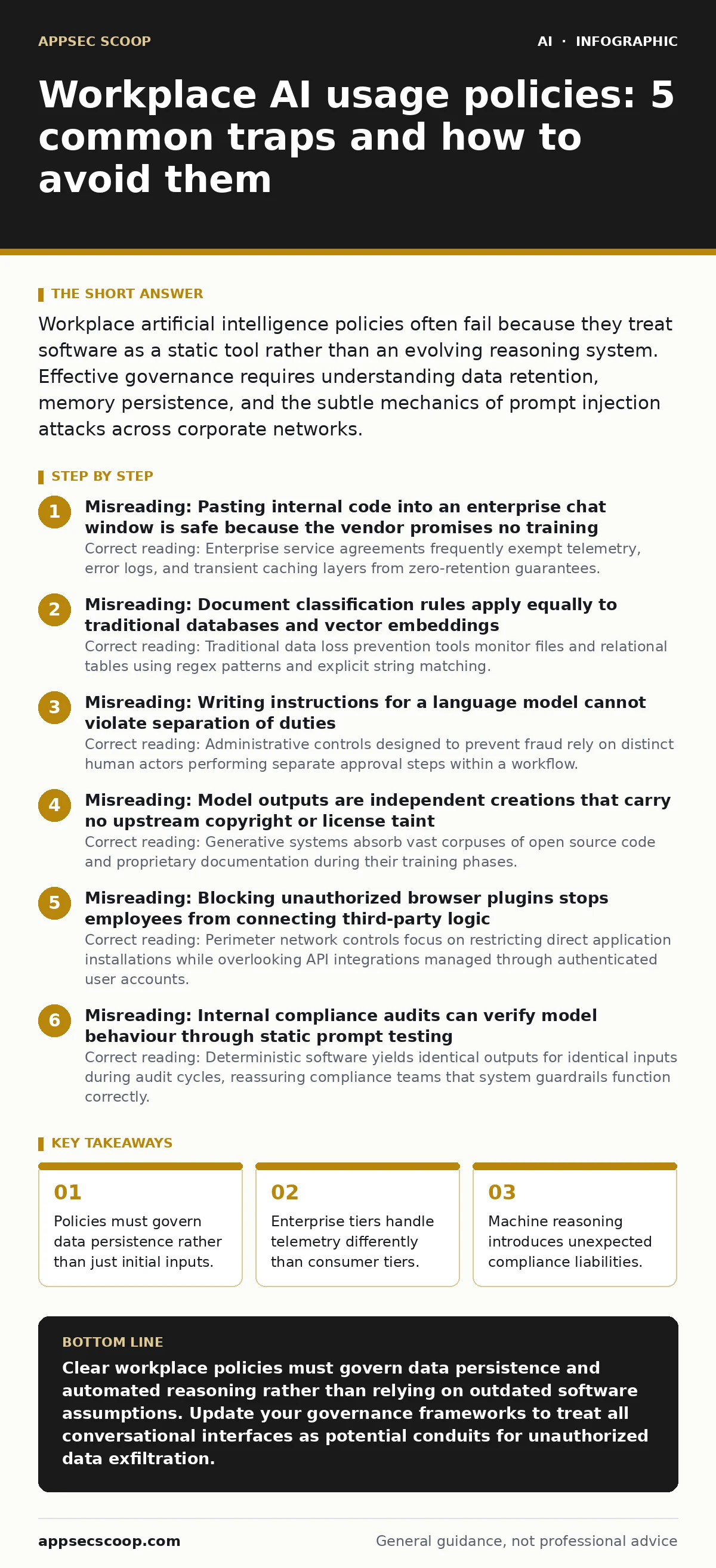
Misreading: Document classification rules apply equally to traditional databases and vector embeddings
Correct reading: Traditional data loss prevention tools monitor files and relational tables using regex patterns and explicit string matching. Modern applications convert sensitive documents into numerical representations stored in vector databases, rendering legacy perimeter defences blind to semantic extraction.
Employees often upload proprietary architecture diagrams or financial spreadsheets into summarisation tools, believing the resulting mathematical weights bear no relation to the original text. Mathematical transformations obscure provenance while retaining underlying conceptual relationships, allowing indirect reconstruction of restricted facts through targeted querying techniques.
Misreading: Writing instructions for a language model cannot violate separation of duties
Correct reading: Administrative controls designed to prevent fraud rely on distinct human actors performing separate approval steps within a workflow. Automated assistants blur these boundaries by generating code, reviewing compliance logs, and drafting financial transfers within a single continuous session.
Systemic risk emerges when single operators orchestrate multi-stage tasks through programmatic interfaces without independent verification checks. Operational security demands treating natural language prompts as execution scripts that can bypass traditional authorisation matrices through clever framing.
Misreading: Model outputs are independent creations that carry no upstream copyright or license taint
Correct reading: Generative systems absorb vast corpuses of open source code and proprietary documentation during their training phases. Developers frequently paste generated snippets into production repositories, assuming the software output constitutes clean room engineering free from upstream licensing obligations.
Legal liability arises when generated code mirrors copyrighted training data closely enough to trigger infringement claims or copyleft viral provisions. Engineering guidelines must account for the reality that probabilistic synthesis inherits the legal ambiguities of its underlying training material without transparent provenance tracking.
Misreading: Blocking unauthorized browser plugins stops employees from connecting third-party logic
Correct reading: Perimeter network controls focus on restricting direct application installations while overlooking API integrations managed through authenticated user accounts. Staff members routinely connect external automation platforms to internal software repositories using OAuth tokens, bypassing browser-level restrictions entirely.
Integration grants external services continuous access to corporate data stores through legitimate application programming interfaces. Governance frameworks inspired by the NIST AI Risk Management Framework must incorporate continuous token auditing alongside traditional endpoint monitoring to maintain visibility over automated workflows.
See also: The difference between embeddings and tokens and why it matters
Misreading: Internal compliance audits can verify model behaviour through static prompt testing
Correct reading: Deterministic software yields identical outputs for identical inputs during audit cycles, reassuring compliance teams that system guardrails function correctly. Probabilistic models respond to subtle phrasing variations, context window lengths, and temperature settings, rendering static test suites largely ineffective against adaptive edge cases.
Auditors must test for adversarial examples and boundary conditions that trigger unintended reasoning paths rather than relying on standard benchmark queries. Effective verification requires continuous red teaming exercises that simulate how malicious actors manipulate model logic through indirect data injection.
Key takeaways
- Policies must govern data persistence rather than just initial inputs.
- Enterprise tiers handle telemetry differently than consumer tiers.
- Machine reasoning introduces unexpected compliance liabilities.
Clear workplace policies must govern data persistence and automated reasoning rather than relying on outdated software assumptions. Update your governance frameworks to treat all conversational interfaces as potential conduits for unauthorized data exfiltration.
Frequently asked questions
Can internal AI usage be monitored effectively using standard data loss prevention tools?
Standard data loss prevention tools struggle with artificial intelligence because they rely on exact string matching rather than semantic understanding. Monitoring requires inspecting API payloads and tracking how textual data converts into mathematical representations.
Why do enterprise subscription tiers still present security risks for corporate data?
Enterprise tiers prevent vendors from using submitted prompts to train future models, but they still retain data for abuse monitoring, debugging, and system logging. This residual storage creates windows where sensitive information resides on third-party infrastructure.
How do vector databases complicate traditional data classification policies?
Vector databases store information as numerical coordinates rather than readable text, which bypasses legacy keyword filters and file-type monitors. This transformation makes it difficult for automated security tools to detect when proprietary concepts leave the corporate perimeter.
What makes prompt-based instructions harder to audit than traditional software code?
Natural language instructions lack the rigid syntax and deterministic execution paths of traditional programming languages. Minor variations in phrasing can produce radically different operational behaviours, making static compliance checks insufficient.
How this guide was produced: written by the AppSec Scoop editorial team with AI assistance, checked against the public references listed below, and reviewed when the facts change. See our editorial policy or report an error.