
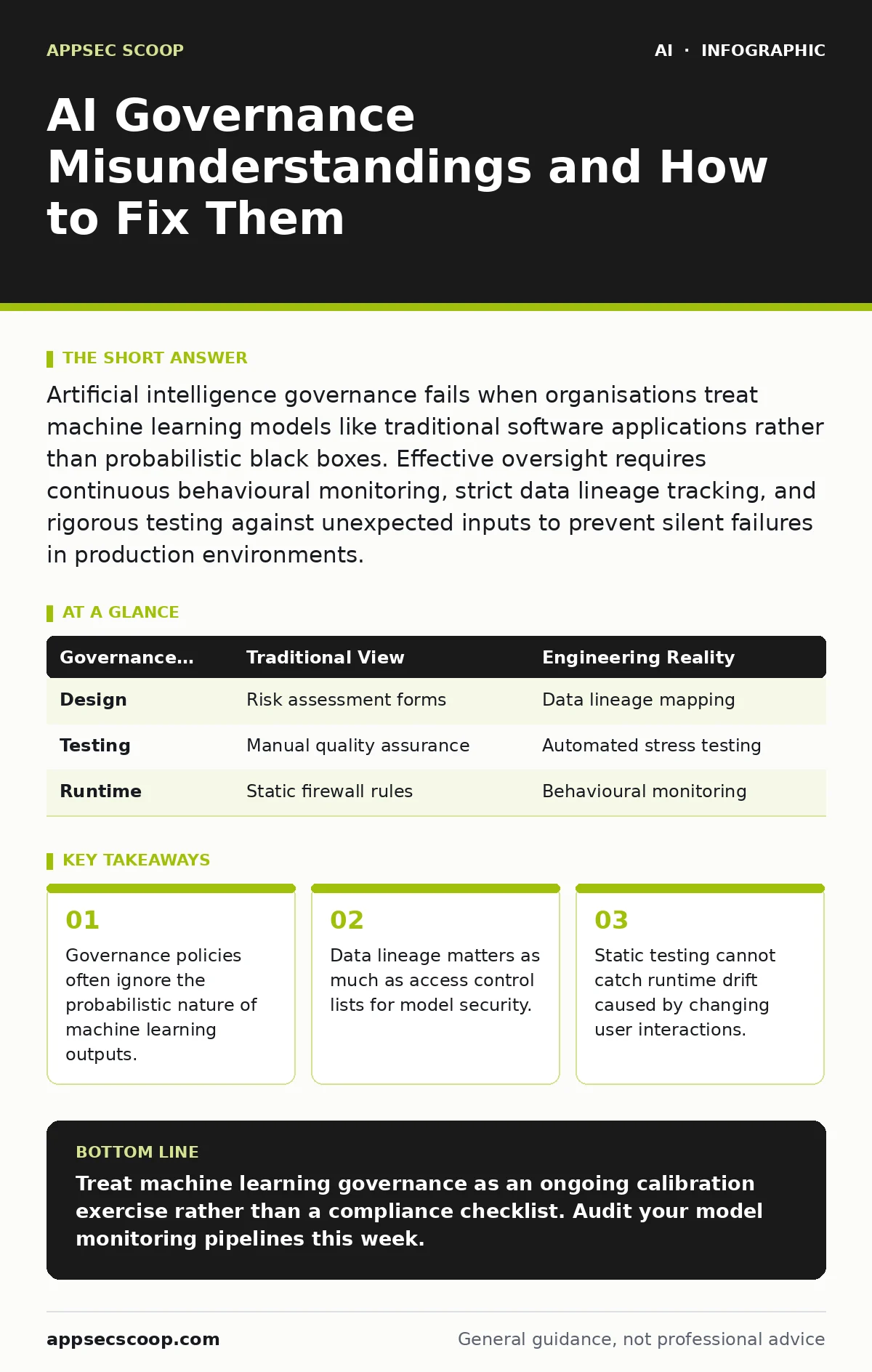
Artificial intelligence governance fails when organisations treat machine learning models like traditional software applications rather than probabilistic black boxes. Effective oversight requires continuous behavioural monitoring, strict data lineage tracking, and rigorous testing against unexpected inputs to prevent silent failures in production environments.
Misreading: AI governance is primarily a legal and compliance obligation
Correct reading: Treating governance as a set of paper policies creates a false sense of security while leaving technical pipelines entirely unprotected. Legal frameworks cannot prevent a neural network from hallucinating incorrect instructions or leaking memorised training data leakage when queried cleverly. 3 distinct engineering controls must back every policy document: automated output validation, runtime rate limiting, and continuous behaviour logging. Software engineering teams need operational metrics that measure model drift, not just sign-offs from risk committees.
Misreading: Models inherit the security boundaries of their hosting infrastructure
Correct reading: Container isolation and network firewalls protect the operating system, but they remain completely blind to semantic manipulation occurring inside the model weights. An attacker can bypass traditional perimeter defences by hiding malicious instructions within normal text inputs that the underlying algorithm parses as valid commands. 4 layers of semantic inspection are required to catch these logic flaws before they reach execution layers. You must monitor what the model actually understands, not just who is allowed to send network traffic to the endpoint.
Misreading: Standard input sanitisation stops malicious prompts
Correct reading: Traditional security tools rely on regular expressions and signature matching to block known attack patterns, which fails utterly against flexible language models. Attackers bypass these filters easily by encoding malicious concepts into embeddings that represent semantic meaning rather than literal character strings. 2 inputs that look completely different to a character filter can translate to identical numerical vectors inside the model's latent space. Effective governance requires semantic boundary enforcement that analyses the contextual meaning of requests rather than searching for forbidden words.
Misreading: High prediction accuracy guarantees safe behaviour
Correct reading: A model can achieve near-perfect performance benchmarks while remaining dangerously vulnerable to edge cases that trigger catastrophic failures. High accuracy simply means the algorithm performs well on historical test sets, providing zero assurance about how it handles novel adversarial examples designed specifically to exploit blind spots. 5 distinct stress-testing methodologies should run continuously against production endpoints to uncover hidden failure modes. You must measure resilience alongside accuracy to understand how the system behaves under deliberate pressure.
Misreading: Comprehensive logging solves post-deployment auditing
Correct reading: Collecting gigabytes of request and response logs generates noise rather than clarity if security teams lack the context to interpret probabilistic outputs. Because machine learning systems generate different answers to identical inputs over time due to temperature settings or backend updates, static log analysis fails to catch subtle regressions. 3 specialised monitoring pipelines are necessary to track token usage, semantic consistency, and latency anomalies simultaneously. When treating AI models as untrusted insiders, you must record internal activation states alongside external text to diagnose unexpected behaviour accurately.
See also: AI risk management: how to govern machine learning systems · Data Classification for Small Teams: Low-Cost Methods
Misreading: Governance inevitably halts engineering velocity
Correct reading: Effective governance actually accelerates delivery by catching architectural flaws before code reaches production environments where fixes become exponentially more expensive. When engineering teams build automated validation checks directly into their continuous integration pipelines, compliance happens as a natural byproduct of development rather than a bureaucratic bottleneck. 2 automated test suites running in parallel can verify both functional correctness and safety constraints within minutes.
| Governance Phase | Traditional View | Engineering Reality |
|---|---|---|
| Design | Risk assessment forms | Data lineage mapping |
| Testing | Manual quality assurance | Automated stress testing |
| Runtime | Static firewall rules | Behavioural monitoring |
Key takeaways
- Governance policies often ignore the probabilistic nature of machine learning outputs.
- Data lineage matters as much as access control lists for model security.
- Static testing cannot catch runtime drift caused by changing user interactions.
Treat machine learning governance as an ongoing calibration exercise rather than a compliance checklist. Audit your model monitoring pipelines this week.
Frequently asked questions
Why do traditional application security tools fail to secure machine learning models?
Traditional security tools inspect syntax and structure, whereas machine learning systems process semantic meaning through probabilistic calculations that bypass syntactic filters entirely.
How often should an organisation update its model evaluation datasets?
Evaluation datasets require continuous updates to reflect shifting user behaviours and newly discovered edge cases that were absent during initial training phases.
What is the primary difference between deterministic software testing and probabilistic model evaluation?
Deterministic software produces identical outputs for identical inputs every single time, while probabilistic models can return different results based on internal weights and sampling parameters.
Can automated tools completely replace human oversight in artificial intelligence governance?
Automated tools can catch known failure patterns at scale, but human analysts remain essential for investigating novel failure modes and defining acceptable risk tolerances.
How this guide was produced: written by the AppSec Scoop editorial team with AI assistance, checked against the public references listed below, and reviewed when the facts change. See our editorial policy or report an error.