
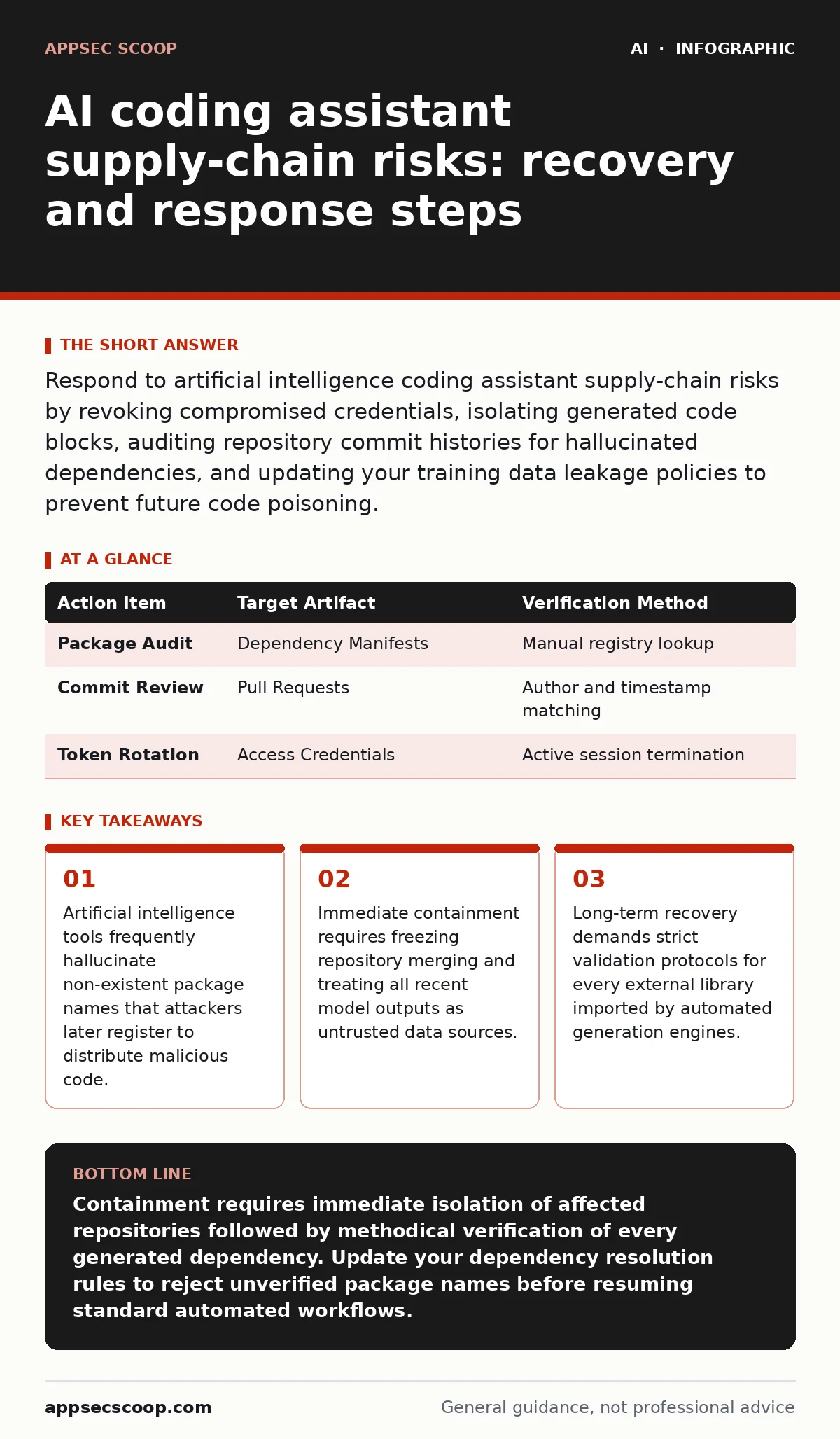
Respond to artificial intelligence coding assistant supply-chain risks by revoking compromised credentials, isolating generated code blocks, auditing repository commit histories for hallucinated dependencies, and updating your training data leakage policies to prevent future code poisoning.
AI coding assistant supply-chain risks and how they manifest
Artificial intelligence coding assistants introduce unique supply-chain risks when models suggest third-party libraries that do not actually exist in public repositories. Attackers monitor these generation patterns and register malicious packages under those exact names, waiting for developers to accept the suggestion.
When automated tools generate import statements for these ghost packages, package managers blindly fetch the attacker-controlled code into your build pipeline. Standard dependency scanners fail to flag these imports because the original suggestion seemed harmless during the code review process. You must understand that treating AI models as untrusted insiders helps prevent blind acceptance of generated code structures.
First hour
Immediate containment steps require rapid action to prevent malicious packages from spreading deeper into your software architecture. Automated code generation tools must be disconnected from repositories immediately to halt further ingestion of poisoned suggestions.
- Revoke all active API tokens associated with the affected development environment.
- Pause continuous integration pipelines to stop automated builds from fetching external packages.
- Notify the internal security operations team via secure out-of-band communication channels.
- Export current memory dumps and ephemeral logs from developer workstations for forensic analysis.
Isolating the affected environment stops lateral movement while preserving volatile state data required for subsequent investigations.
First day
Comprehensive containment requires deep inspection of recent commit histories to identify every instance of machine-generated code. Developers must manually verify every external dependency introduced during the active window of potential compromise.
| Action Item | Target Artifact | Verification Method |
|---|---|---|
| Package Audit | Dependency Manifests | Manual registry lookup |
| Commit Review | Pull Requests | Author and timestamp matching |
| Token Rotation | Access Credentials | Active session termination |
Cross-referencing manifest files against official package registries uncovers unverified imports. Reviewing your NIST AI Risk Management Framework policies ensures organizational alignment during these high-pressure containment efforts.
First week
Recovery operations focus on rebuilding trust in your software supply chain through rigorous code sanitisation and validation checks. Engineers must scrutinise every function block generated during the incident window before returning systems to normal production states.
- Rebuild development containers from known clean baseline images stored in secure internal registries.
- Scan all remaining source code repositories for latent behavioral anomalies using static analysis tools.
- Establish mandatory human-in-the-loop review gates for every future library suggestion generated by automation.
Restoring normal operations takes time because rushed validation often leaves hidden backdoors active in production binaries.
Who to tell
Internal stakeholders and external partners require precise communication regarding the nature of the compromised code generation pipeline. Legal counsel, executive leadership, and downstream customers need factual summaries without speculative language about attacker motivations.
| Recipient Group | Required Information | Timing Constraint |
|---|---|---|
| Executive Team | Scope of exposure | Within 4 hours |
| Legal Counsel | Data jurisdiction impact | Within 8 hours |
| Affected Clients | Remediation status | Upon verification |
Clear reporting lines prevent panic and ensure regulatory compliance requirements are met without disclosing sensitive internal architecture details.
See also: How Typosquatting Works: The Step-by-Step Attack Lifecycle
How to stop a repeat
Stopping repeated supply-chain compromises requires structural changes to how development teams interact with automated coding tools. You must implement strict allowlists for permitted external libraries and block any automatic resolution of unknown package names.
Enforcing deterministic builds guarantees that your compilation pipeline only retrieves cryptographically verified source archives. Reviewing your AI vendor assessments regularly ensures that third-party generation tools adhere to strict internal safety baselines.
Key takeaways
- Artificial intelligence tools frequently hallucinate non-existent package names that attackers later register to distribute malicious code.
- Immediate containment requires freezing repository merging and treating all recent model outputs as untrusted data sources.
- Long-term recovery demands strict validation protocols for every external library imported by automated generation engines.
Containment requires immediate isolation of affected repositories followed by methodical verification of every generated dependency. Update your dependency resolution rules to reject unverified package names before resuming standard automated workflows.
Frequently asked questions
Can static analysis tools detect malicious packages suggested by coding assistants?
Standard static analyzers only check existing code syntax and known vulnerability signatures, meaning they frequently miss brand-new malicious packages registered to match hallucinated names.
How do attackers discover which package names to register?
Attackers analyze public model output patterns and error logs to identify frequently hallucinated library names that do not yet exist in public package registries.
Should developers disable code generation tools entirely after an incident?
Disabling tools entirely is rarely necessary, but you must restrict their network access and enforce strict manual review for all suggested import statements.
What role does developer training play in stopping these attacks?
Training teaches developers to treat automated code suggestions with skepticism, specifically regarding the authenticity of unfamiliar third-party libraries.
How this guide was produced: written by the AppSec Scoop editorial team with AI assistance, checked against the public references listed below, and reviewed when the facts change. See our editorial policy or report an error.