
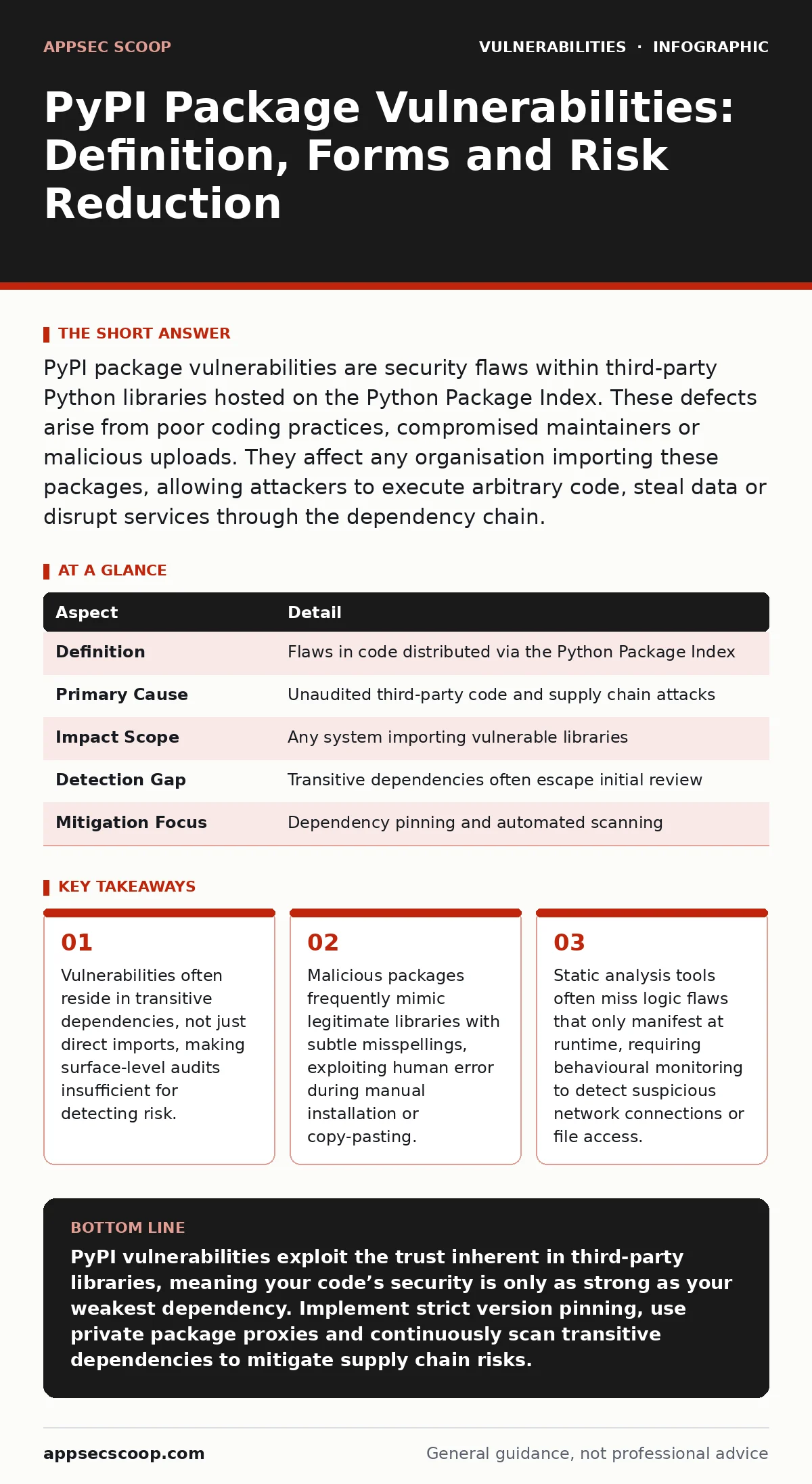
PyPI package vulnerabilities are security flaws within third-party Python libraries hosted on the Python Package Index. These defects arise from poor coding practices, compromised maintainers or malicious uploads. They affect any organisation importing these packages, allowing attackers to execute arbitrary code, steal data or disrupt services through the dependency chain.
The Nature of Third-Party Code Risk
Imagine you build a house using pre-fabricated walls. You inspect your own timber and cement, but you trust the manufacturer to have secured the windows and doors. In software development, PyPI packages are those pre-fabricated walls. A vulnerability in a PyPI package is a defect or flaw within a third-party library that an attacker can exploit to compromise the host application. This risk exists because developers rarely audit every line of code in every dependency they install. The assumption that public packages are safe creates a blind spot in the security posture.
| Aspect | Detail |
|---|---|
| Definition | Flaws in code distributed via the Python Package Index |
| Primary Cause | Unaudited third-party code and supply chain attacks |
| Impact Scope | Any system importing vulnerable libraries |
| Detection Gap | Transitive dependencies often escape initial review |
| Mitigation Focus | Dependency pinning and automated scanning |
How Supply Chain Failures Occur
The mechanism behind these failures is straightforward but pervasive. Developers use package managers like pip to fetch libraries from PyPI. These libraries often depend on other libraries, creating a tree of transitive dependencies. A vulnerability can exist anywhere in this tree. If a maintainer introduces a flaw, or if an attacker compromises the maintainer's account, the malicious code propagates to every project that imports it. This is a classic supply chain attack. The attacker does not target your application directly. They target the tool your application trusts.
The Python ecosystem encourages rapid iteration and open contribution. This openness is a strength for development speed but a weakness for security verification. Code reviews are often informal. Automated checks may not catch logical errors or insecure defaults. When a new version is published, it may introduce breaking changes or new flaws. If your project does not pin versions tightly, you may inadvertently update to a vulnerable version without realising it.
Who Bears the Consequence
The impact extends far beyond the immediate developer. Any organisation that runs Python applications is exposed. Web frameworks, data science pipelines, automation scripts and machine learning models all rely on PyPI packages. If a vulnerability allows remote code execution, the attacker gains the same privileges as the application. This often means access to databases, internal networks and sensitive configuration files.
Security operations teams face a unique challenge here. Traditional perimeter defenses cannot detect code that is already trusted and running inside the environment. The attack vector is the dependency itself. This mirrors the complexity found in remote code execution vulnerabilities, where the entry point is valid code rather than malicious input. The blast radius depends on the privilege level of the process running the Python script. A high-privilege service becomes a high-value target.
Common Manifestations of Package Flaws
Vulnerabilities in Python packages take several distinct forms. Understanding these forms helps in identifying risk during code reviews and audits.
- Dependency Confusion: Attackers upload internal packages to PyPI with higher version numbers, tricking package managers into pulling malicious code.
- Typosquatting: Malicious packages use names similar to popular libraries. Developers accidentally install the wrong package.
- Insecure Deserialization: Libraries that process data formats like YAML or JSON without validation can execute arbitrary code during deserialization.
- Hardcoded Secrets: Maintainers accidentally commit API keys or credentials into the library code, which are then distributed to all users.
These forms exploit different weaknesses. Typosquatting exploits human attention. Dependency confusion exploits build system logic. Insecure deserialization exploits implementation flaws. A comprehensive approach to secure software development lifecycle practices must address all these vectors. Relying on a single mitigation strategy leaves gaps.
What People Usually Get Wrong
A common misconception is that deleting a vulnerable package from your dependency list removes the risk. This ignores transitive dependencies. Package A might depend on Package B, which depends on Package C. If Package C is vulnerable, removing Package B does not help if Package A still pulls in Package C through another path. You must analyse the entire dependency tree.
Another error is assuming that pinning versions to the latest stable release is sufficient. The latest release may contain a newly discovered flaw. You need a process for vulnerability remediation SLAs that ensures critical patches are applied quickly. Waiting for the next major release cycle can leave systems exposed for months.
Developers also often trust the popularity of a package as a proxy for security. A widely used package has more eyes on it, but it also has a larger attack surface. It is a prime target for typosquatting and dependency confusion. Popularity does not guarantee safety. It guarantees attention, including from adversaries.
See also: Insecure File Permissions: Response, Recovery and Prevention Steps
Reducing Risk Through Structural Controls
Mitigation requires a layered approach. Start by pinning exact versions of all dependencies. This ensures reproducibility and prevents unexpected updates. Use tools that scan your dependency tree against known vulnerability databases. These tools can identify flaws in transitive dependencies that you do not directly import.
Implement private proxies or mirrors for your package registry. This allows you to block known malicious packages and enforce allow-lists. Only approved packages can be installed. This reduces the risk of typosquatting and dependency confusion.
Regularly update dependencies, but test thoroughly before deployment. Coordinate updates to avoid breaking changes. Document the security posture of your dependencies. If a library handles sensitive data, consider auditing its source code or replacing it with a more secure alternative.
This approach aligns with broader security principles. Just as insecure file permissions can expose local resources, insecure dependency management exposes your application to remote threats. The goal is to reduce the attack surface and increase the cost for attackers. You cannot eliminate risk, but you can manage it effectively through disciplined processes and continuous monitoring. Understanding attack vectors in CVSS helps prioritise which vulnerabilities to fix first based on their potential impact.
Integrating with Broader Security Practices
PyPI vulnerabilities are not an isolated issue. They fit into the wider context of application security. When evaluating risk, consider how these flaws interact with other weaknesses. A vulnerable package might expose an endpoint that is susceptible to NoSQL injection if the application uses a NoSQL database. The combination of flaws can be more dangerous than either alone.
Responsible disclosure practices also matter. If you find a flaw in a package, report it to the maintainer privately before publishing details. This gives them time to patch the issue. Public disclosure without a fix exposes all users to immediate risk.
IoT device patching offers a parallel lesson. Many IoT devices run lightweight Python scripts. If these devices cannot be easily updated, they become permanent vectors for attack. Ensuring your Python dependencies are secure is part of a broader strategy to protect all software assets.
Key takeaways
- Vulnerabilities often reside in transitive dependencies, not just direct imports, making surface-level audits insufficient for detecting risk.
- Malicious packages frequently mimic legitimate libraries with subtle misspellings, exploiting human error during manual installation or copy-pasting.
- Static analysis tools often miss logic flaws that only manifest at runtime, requiring behavioural monitoring to detect suspicious network connections or file access.
PyPI vulnerabilities exploit the trust inherent in third-party libraries, meaning your code’s security is only as strong as your weakest dependency. Implement strict version pinning, use private package proxies and continuously scan transitive dependencies to mitigate supply chain risks.
Frequently asked questions
How do I find vulnerable packages in my project?
Use software composition analysis tools that scan your dependency tree against known vulnerability databases. These tools provide reports on direct and transitive dependencies.
Is pinning versions enough to secure my application?
No. Pinning prevents unexpected updates but does not fix existing flaws. You must still scan for known vulnerabilities and apply patches when available.
What is the difference between a direct and transitive dependency?
A direct dependency is a package you explicitly import in your code. A transitive dependency is a package required by one of your direct dependencies. Both can contain vulnerabilities.
Should I avoid using PyPI packages entirely?
No. Avoiding PyPI is impractical for most Python projects. Instead, adopt strict governance, audit critical libraries and monitor for security advisories to manage the risk effectively.
How this guide was produced: written by the AppSec Scoop editorial team with AI assistance, checked against the public references listed below, and reviewed when the facts change. See our editorial policy or report an error.