
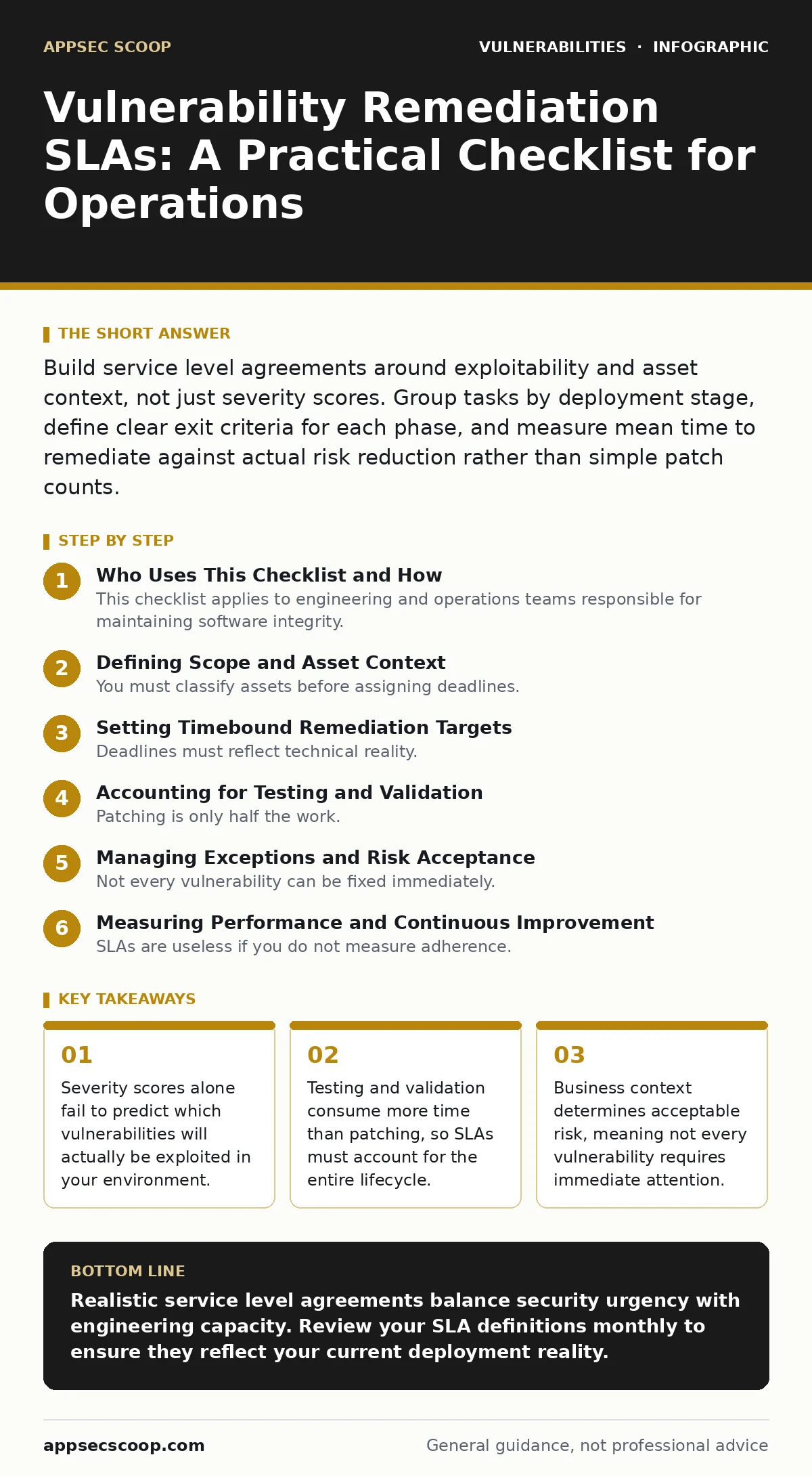
Build service level agreements around exploitability and asset context, not just severity scores. Group tasks by deployment stage, define clear exit criteria for each phase, and measure mean time to remediate against actual risk reduction rather than simple patch counts.
Who Uses This Checklist and How
This checklist applies to engineering and operations teams responsible for maintaining software integrity. You use it to define realistic expectations for fixing defects. Do not treat this as a static document. Review it whenever your deployment pipeline changes or new asset classes enter your infrastructure. The goal is to align security requirements with engineering capacity.
Defining Scope and Asset Context
You must classify assets before assigning deadlines. A vulnerability in a public-facing web server carries different risk than one in an internal development tool. Context drives priority.
- Classify assets by exposure level: one-line reason is that internet-facing systems require faster response than isolated internal networks.
- Identify data sensitivity hosted on each asset: one-line reason is that breach impact scales with the value of the data stored.
- Map dependencies for each vulnerable component: one-line reason is that fixing one module may break dependent services.
- Determine business criticality of the service: one-line reason is that downtime costs often exceed the risk of a theoretical exploit.
Refer to the guide on vulnerability prioritization when you need to weigh these factors against available resources.
Setting Timebound Remediation Targets
Deadlines must reflect technical reality. A generic thirty-day window ignores the complexity of modern software stacks. You need differentiated targets based on exploitability.
- Define emergency SLA for actively exploited flaws: one-line reason is that known exploits guarantee compromise if left unpatched.
- Set high-priority SLA for critical severity with no exploit: one-line reason is that high severity indicates significant potential impact.
- Establish medium-priority SLA for moderate severity issues: one-line reason is that these require attention but allow for scheduled maintenance.
- Create low-priority SLA for informational or theoretical risks: one-line reason is that some findings require no immediate code change.
Consider how attack vectors in CVSS scoring influence these timelines. A network-accessible flaw demands faster action than a local privilege escalation.
Accounting for Testing and Validation
Patching is only half the work. Validation ensures the fix works and does not break existing functionality. Many teams fail SLAs because they ignore this phase.
- Include automated regression testing in SLA clock: one-line reason is that automated checks provide immediate feedback on stability.
- Allocate time for manual security verification: one-line reason is that automated tools miss complex logic errors and side effects.
- Define rollback procedures for failed patches: one-line reason is that a broken service is worse than a vulnerable one.
- Document validation success criteria explicitly: one-line reason is that ambiguity leads to skipped testing steps.
See the section on patch management to understand how automated pipelines can reduce validation overhead.
Managing Exceptions and Risk Acceptance
Not every vulnerability can be fixed immediately. Some systems are legacy, some vendors do not provide patches, and some fixes break core functionality. You must have a formal process for these cases.
- Require business sign-off for risk acceptance: one-line reason is that accountability must rest with those who own the risk.
- Define compensating controls for accepted risks: one-line reason is that isolation or monitoring mitigates the lack of a patch.
- Set expiration dates for all exceptions: one-line reason is that temporary risks become permanent liabilities if not revisited.
- Log all exceptions in a central register: one-line reason is that auditors require evidence of deliberate risk decisions.
Imagine a scenario where a critical library has no upstream fix. You cannot patch it. You must isolate the service or accept the risk formally.
See also: Responsible Disclosure Myths: 6 Ways Teams Misuse the Process · Zero-Day vs N-Day: Deciding Which Vulnerability Model Fits Your Stack
Measuring Performance and Continuous Improvement
SLAs are useless if you do not measure adherence. Tracking mean time to remediate helps you identify bottlenecks. You need metrics that reflect actual security posture, not just compliance checkboxes.
- Track mean time to remediate per asset class: one-line reason is that trends reveal systemic process failures.
- Review false positives from scanning tools: one-line reason is that noise wastes engineering time and delays real fixes.
- Conduct post-mortems for missed critical SLAs: one-line reason is that understanding failure causes prevents recurrence.
Check for vulnerabilities in PyPI packages regularly, as third-party dependencies often introduce unexpected delays in remediation cycles.
Integrating with Development Workflows
Security cannot be an afterthought. Embed SLA checks into your continuous integration and continuous delivery pipelines. This ensures that vulnerabilities are addressed before they reach users.
- Block merges for critical unpatched dependencies: one-line reason is that preventing introduction is easier than fixing later.
- Notify developers of SLA breaches early: one-line reason is that early warnings allow for better planning and resource allocation.
- Automate SLA tracking in ticketing systems: one-line reason is that manual tracking is prone to error and oversight.
- Align security sprints with development cycles: one-line reason is that dedicated time ensures consistent progress on remediation.
Key takeaways
- Severity scores alone fail to predict which vulnerabilities will actually be exploited in your environment.
- Testing and validation consume more time than patching, so SLAs must account for the entire lifecycle.
- Business context determines acceptable risk, meaning not every vulnerability requires immediate attention.
Realistic service level agreements balance security urgency with engineering capacity. Review your SLA definitions monthly to ensure they reflect your current deployment reality.
Frequently asked questions
How do you handle third-party vulnerabilities with no available patch?
Implement compensating controls such as network segmentation or web application firewall rules. Formally accept the risk with business sign-off and set a review date.
Should internal tools have the same SLAs as production systems?
No. Internal tools with limited access and lower data sensitivity should have longer remediation windows. Align deadlines with actual exploitability and impact.
What is the difference between SLA and SLO in vulnerability management?
Service level agreements are commitments to fix vulnerabilities within a time frame. Service level objectives are the actual performance targets you aim to achieve.
How often should you review your vulnerability remediation SLAs?
Review them quarterly or whenever your infrastructure changes significantly. Regular reviews ensure deadlines remain realistic and aligned with business priorities.
How this guide was produced: written by the AppSec Scoop editorial team with AI assistance, checked against the public references listed below, and reviewed when the facts change. See our editorial policy or report an error.