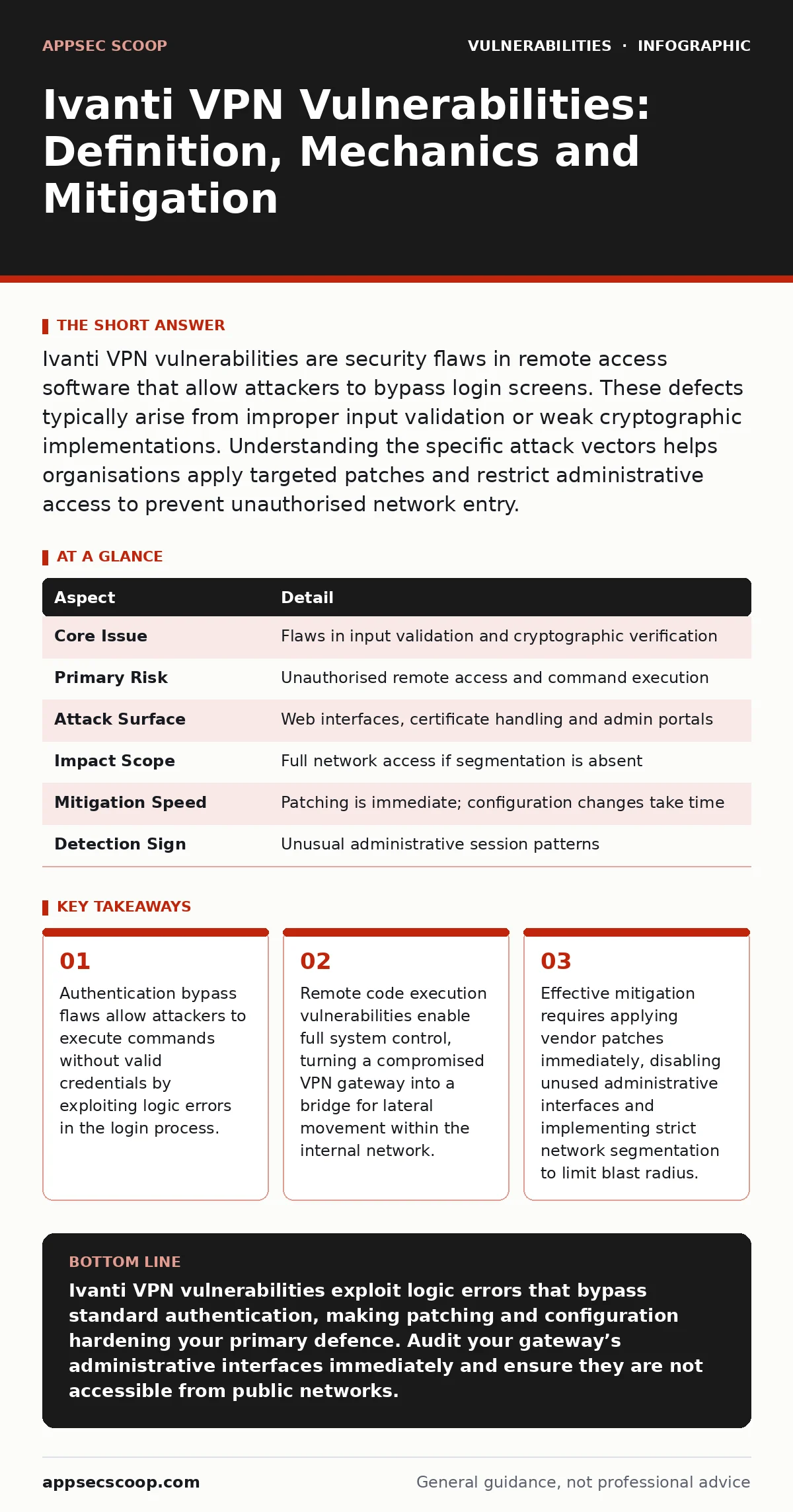
Ivanti VPN vulnerabilities are security flaws in remote access software that allow attackers to bypass login screens. These defects typically arise from improper input validation or weak cryptographic implementations. Understanding the specific attack vectors helps organisations apply targeted patches and restrict administrative access to prevent unauthorised network entry.
How Remote Access Security Fails
Imagine a building with a secure front door. The lock is complex, requiring a key and a PIN. Now suppose the maintenance entrance has a keypad that anyone can reset by pressing a specific sequence of buttons, regardless of whether they hold a key. The main door remains secure, but the building is already compromised. Ivanti VPN vulnerabilities operate on this principle. The primary authentication mechanism often remains intact, but secondary processes, such as certificate validation or administrative interfaces, contain flaws that attackers exploit to bypass the initial barrier.
| Aspect | Detail |
|---|---|
| Core Issue | Flaws in input validation and cryptographic verification |
| Primary Risk | Unauthorised remote access and command execution |
| Attack Surface | Web interfaces, certificate handling and admin portals |
| Impact Scope | Full network access if segmentation is absent |
| Mitigation Speed | Patching is immediate; configuration changes take time |
| Detection Sign | Unusual administrative session patterns |
These vulnerabilities do not usually stem from weak passwords. They arise from how the software processes data before checking who sent it. When the system trusts a request’s structure over its origin, an attacker can forge a valid-looking request. This distinction matters because changing passwords does not fix the underlying logic error. The flaw exists in the code that decides whether a request is legitimate, not in the credentials the user provides.
The Mechanics of Authentication Bypass
The most common form of Ivanti VPN vulnerability involves authentication bypass. This occurs when the application fails to verify that a user has successfully logged in before granting access to protected resources. An attacker sends a specially crafted request that tricks the server into believing the authentication step has already occurred. The server processes the request as if it came from a verified administrator.
This happens because the application state is not properly maintained between requests. The server might accept a command based on a cookie or a header that the attacker can forge. If the code does not re-verify the user’s identity for each sensitive action, the forged request succeeds. This is not a brute-force attack. It is a logic error that allows the attacker to skip the lock entirely.
Who Is Exposed to These Flaws
Any organisation using Ivanti VPN solutions for remote access is potentially affected. The risk is highest for entities that expose the VPN gateway directly to the internet. If the gateway sits behind a firewall with strict access controls, the attack surface shrinks. However, if the device is accessible from public networks, it becomes a target for automated scanning tools.
Small and medium-sized businesses are often more vulnerable than large enterprises. Large organisations typically have dedicated security teams that monitor for new vulnerabilities and apply patches quickly. Smaller teams may lack the resources to track every security bulletin. They might rely on default configurations that leave administrative interfaces open. The presence of the vulnerability is universal, but the ability to exploit it depends on exposure and patching speed.
Common Forms of Exploitation
Attackers use several methods to exploit these vulnerabilities. The first is remote code execution. This allows the attacker to run arbitrary commands on the VPN server. Once inside, they can install malware, steal data or move laterally to other systems. The second method is information disclosure. Flaws in how the system handles error messages or debug information can reveal sensitive details about the network structure.
A third form involves privilege escalation. Even if an attacker gains limited access, flaws in permission handling might allow them to elevate their rights to administrator level. This is particularly dangerous because it turns a minor breach into a full compromise. The attack often starts with a low-privilege user account and ends with total control. Understanding these forms helps in detecting unusual activity. A sudden spike in administrative logins or unexpected command executions are strong indicators of an active exploit.
What People Usually Get Wrong
Many assume that updating the software solves the problem permanently. Patching is necessary, but it is not sufficient. If the underlying configuration remains insecure, new vulnerabilities will emerge. Another common mistake is relying solely on multi-factor authentication. MFA protects the login screen, but it does not protect against logic flaws that bypass the screen entirely. If the code accepts a request without checking MFA status, the extra factor is irrelevant.
Organisations also often ignore the principle of least privilege. They grant administrative access to users who do not need it. When a vulnerability is exploited, the attacker inherits these excessive rights. Restricting access to only those who require it limits the damage. Security is not just about fixing the code. It is about designing the environment so that a single failure does not cascade into a total breach.
See also: Risk-Based Vulnerability Management: Prioritise Fixes That Matter · Responsible Disclosure Myths: 6 Ways Teams Misuse the Process
Reducing Risk Through Configuration
Mitigating these risks requires a layered approach. The first step is applying all available patches from the vendor. This fixes known code flaws. The second step is disabling unused features. If the administrative web interface is not needed for remote management, it should be turned off or restricted to specific internal IP addresses. This reduces the attack surface significantly.
Network segmentation is the third critical measure. The VPN gateway should not have direct access to sensitive internal systems. Place it in a demilitarised zone with strict rules governing what traffic can pass through. This ensures that even if the gateway is compromised, the attacker cannot easily reach the core network. Regular audits of access logs help detect suspicious activity early. Look for patterns that do not match normal user behaviour, such as logins at unusual times or from unfamiliar locations.
The Hidden Cost of Default Trust
The deepest issue with these vulnerabilities is the reliance on default trust. Software often assumes that requests come from trusted sources unless proven otherwise. This mindset is dangerous in a public-facing environment. Every request should be treated as hostile until verified. This shift in thinking drives better secure software development lifecycle practices. It encourages developers to validate every input and verify every state change.
Organisations must also consider the lifecycle of their devices. End-of-life software no longer receives patches. Continuing to use unsupported versions exposes the network to unpatched flaws. Planning for regular upgrades and replacements is part of security hygiene. The cost of downtime from a breach far exceeds the cost of maintaining up-to-date systems. Vigilance in configuration and patching is the only reliable defence against evolving threats.
Key takeaways
- Authentication bypass flaws allow attackers to execute commands without valid credentials by exploiting logic errors in the login process.
- Remote code execution vulnerabilities enable full system control, turning a compromised VPN gateway into a bridge for lateral movement within the internal network.
- Effective mitigation requires applying vendor patches immediately, disabling unused administrative interfaces and implementing strict network segmentation to limit blast radius.
Ivanti VPN vulnerabilities exploit logic errors that bypass standard authentication, making patching and configuration hardening your primary defence. Audit your gateway’s administrative interfaces immediately and ensure they are not accessible from public networks.
Frequently asked questions
Do I need to change all user passwords after a patch?
No, these vulnerabilities typically bypass password checks entirely. Changing passwords does not fix the underlying logic flaw, but it is good hygiene if you suspect credentials were stolen during lateral movement.
Can a firewall stop an Ivanti VPN exploit?
A standard firewall cannot stop an exploit that uses valid HTTP or HTTPS traffic. You need an application firewall or web application firewall that can inspect the content of the requests for malicious patterns.
How do I know if my version is vulnerable?
Check the vendor’s security advisories for your specific software version. If your version is listed, you are vulnerable until you apply the recommended patch or upgrade to a newer version.
Is multi-factor authentication enough to prevent this?
No, MFA protects the login process. If the vulnerability allows bypassing the login process entirely, MFA is not triggered. You must patch the software and restrict access to administrative interfaces.
How this guide was produced: written by the AppSec Scoop editorial team with AI assistance, checked against the public references listed below, and reviewed when the facts change. See our editorial policy or report an error.