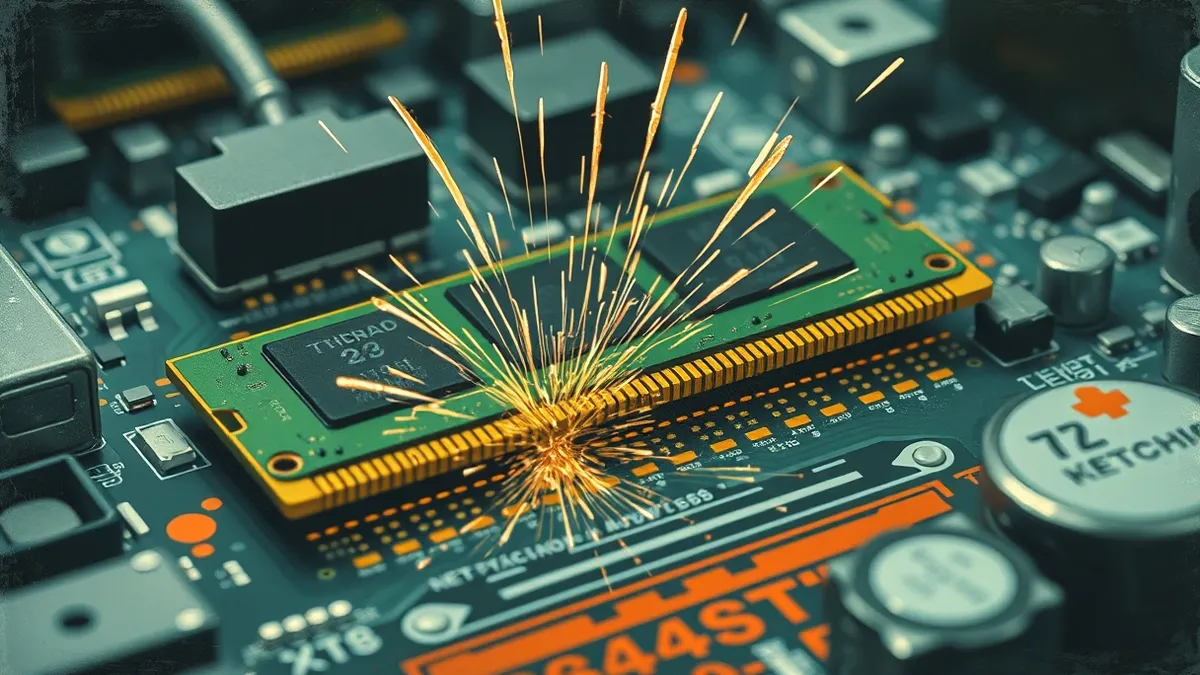
Rowhammer is a hardware-level fault injection attack that flips bits in Dynamic Random Access Memory by repeatedly accessing adjacent rows. It bypasses traditional software security controls because the vulnerability exists in the silicon physics, not the application logic. Mitigation requires hardware-aware strategies, not just code fixes.
Myth: Rowhammer is a software bug that can be patched
Reality: Rowhammer is a physical phenomenon caused by the electrical properties of Dynamic Random Access Memory (DRAM) cells. It is not a logic error in application code or an operating system kernel. The attack works by rapidly accessing a specific memory row, which generates an electrical disturbance that leaks charge from adjacent rows. This charge loss causes bit flips in those neighbouring cells. Because the vulnerability resides in the silicon manufacturing process, updating software libraries or applying operating system patches does not remove the underlying risk. The hardware remains susceptible regardless of the software stack running on it.
Imagine a developer who believes their application is secure because it has passed all static analysis scans. They have eliminated buffer overflows and null pointer dereferences. Yet, an attacker can still manipulate memory contents by hammering specific addresses. This scenario highlights why traditional software development life cycle checks fail here. The code is correct, but the platform it runs on is physically flawed.
Myth: Modern operating systems protect against Rowhammer
Reality: Standard operating system memory management techniques do not stop Rowhammer. Address Space Layout Randomisation (ASLR) randomises memory addresses, but the attacker does not need to know the exact location of the target data. They only need to hammer adjacent rows until a bit flip occurs in a useful location. Data Execution Prevention (DEP) prevents code execution from data regions, but Rowhammer can flip bits in instruction pointers or function tables, redirecting execution without placing new code in memory. The operating system sees these changes as legitimate data modifications because the hardware reports them as valid memory states.
The kernel cannot distinguish between a legitimate write and a bit flip caused by electrical interference. This means that even with strict permission models, an attacker can escalate privileges or bypass sandboxing. The protection model assumes that if you do not have write permission, you cannot change the data. Rowhammer breaks this assumption by changing the data through a side channel that does not require write permissions.
Myth: Only older hardware is vulnerable to Rowhammer
Reality: While early demonstrations used older DIMMs, modern high-density memory chips are often more susceptible, not less. As manufacturers shrink transistor sizes to increase capacity, the electrical isolation between cells decreases. This makes adjacent rows more sensitive to interference from nearby access patterns.
Newer architectures may include hardware mitigations, such as Targeted Row Refresh, but these are not universal. Many consumer and server processors still ship with memory controllers that lack these protections. Assuming that purchasing new equipment eliminates the risk is dangerous. The trend towards higher density actually increases the physical proximity of cells, exacerbating the electrical leakage problem.
Myth: Rowhammer requires physical access to the machine
Reality: Rowhammer can be executed remotely over a network. The attack requires the ability to run code that performs rapid memory accesses. This can be achieved through a web browser using JavaScript, a compromised server process, or a malicious plugin. The attacker does not need to touch the physical hardware. They only need a way to execute instructions that hammer specific memory addresses. This makes Rowhammer a significant threat in cloud environments and multi-tenant systems. One virtual machine can potentially affect another if they share the same physical memory controller and the hypervisor does not isolate memory access patterns effectively.
Suppose an attacker finds a minor flaw in a web application that allows them to execute arbitrary JavaScript. This is not a remote code execution vulnerability in the traditional sense, as they cannot run system commands. However, they can use this foothold to launch a Rowhammer attack. This bridges the gap between a low-severity web flaw and a high-impact hardware exploitation.
Myth: You can detect Rowhammer attacks with standard monitoring
Reality: Detecting Rowhammer is difficult because it leaves no traditional forensic artifacts. There are no suspicious network connections, no unusual file creations, and no error logs generated by the application. The bit flips happen silently at the hardware level. Standard intrusion detection systems monitor network traffic and system calls, neither of which reveal the rapid memory access patterns required for the attack. Even memory dump analysis may not show the attack in progress, as the memory state appears normal except for the corrupted bits.
This invisibility complicates incident response. Security teams may spend hours investigating a system crash caused by a corrupted data structure, never realising that an external actor caused the corruption through electrical interference. The root cause appears to be random hardware failure or software instability, leading to incorrect remediation efforts.
Myth: Rowhammer is too difficult to exploit in practice
Reality: While crafting a precise Rowhammer attack requires technical skill, the barrier to entry has lowered significantly. Researchers have developed tools and scripts that automate the process of finding vulnerable memory patterns and executing the hammering sequences. In browser environments, attackers can use existing web technologies to trigger the attack without custom binaries.
The complexity lies in predicting which bit flips will be useful, but attackers often use probabilistic methods. They hammer memory until a useful change occurs, such as flipping a permission bit or modifying a cryptographic key. This trial-and-error approach is feasible in environments where the attacker can maintain persistent access or run long-duration scripts.
The practical impact depends on the target. In a banking application, flipping a single bit in a transaction amount could be catastrophic. In a web server, it might allow an attacker to bypass authentication. The difficulty does not prevent exploitation; it only increases the time required. For high-value targets, this time investment is justified.
Summary of Rowhammer Misconceptions
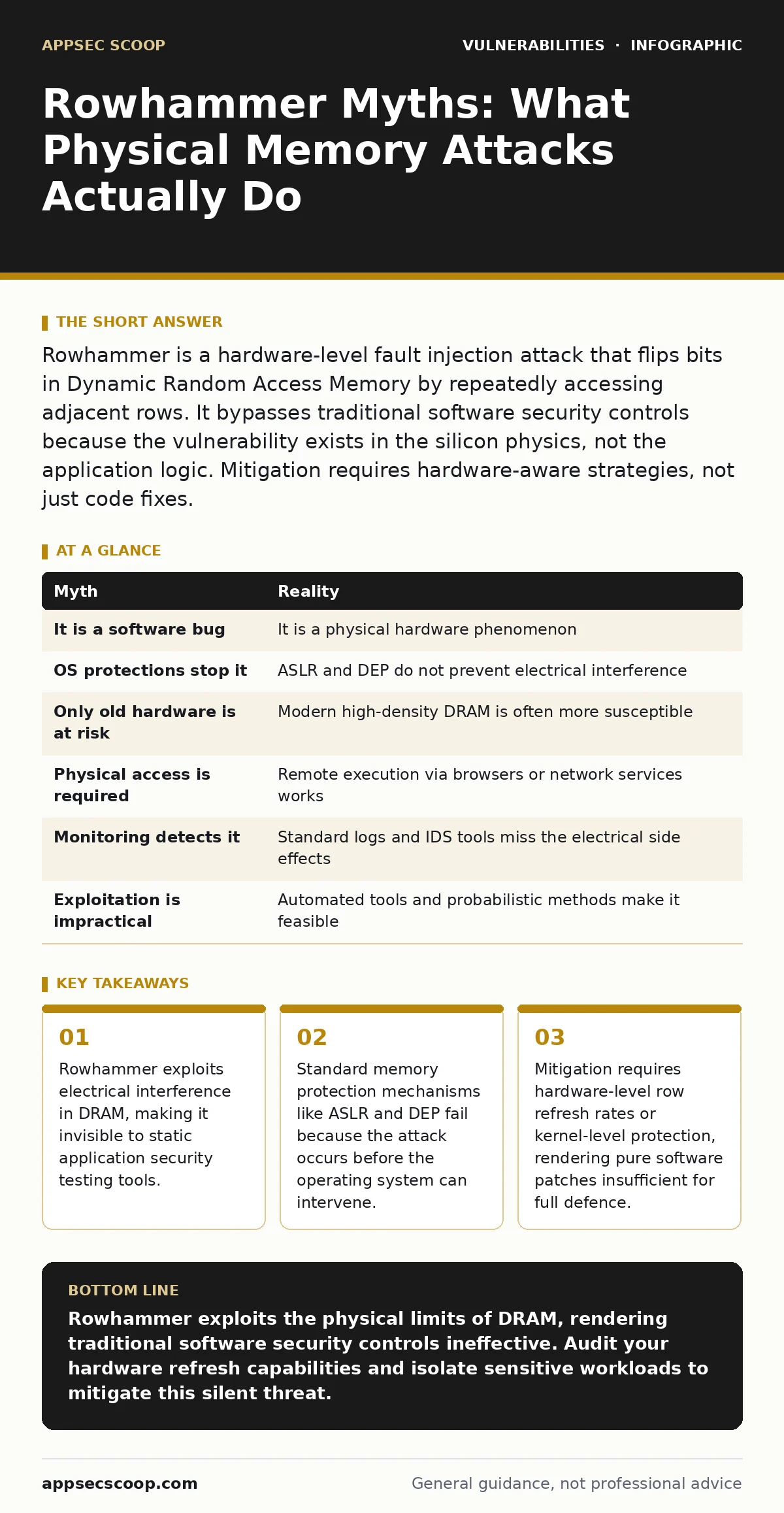
| Myth | Reality |
|---|---|
| It is a software bug | It is a physical hardware phenomenon |
| OS protections stop it | ASLR and DEP do not prevent electrical interference |
| Only old hardware is at risk | Modern high-density DRAM is often more susceptible |
| Physical access is required | Remote execution via browsers or network services works |
| Monitoring detects it | Standard logs and IDS tools miss the electrical side effects |
| Exploitation is impractical | Automated tools and probabilistic methods make it feasible |
Key takeaways
- Rowhammer exploits electrical interference in DRAM, making it invisible to static application security testing tools.
- Standard memory protection mechanisms like ASLR and DEP fail because the attack occurs before the operating system can intervene.
- Mitigation requires hardware-level row refresh rates or kernel-level protection, rendering pure software patches insufficient for full defence.
Rowhammer exploits the physical limits of DRAM, rendering traditional software security controls ineffective. Audit your hardware refresh capabilities and isolate sensitive workloads to mitigate this silent threat.
Frequently asked questions
Does using encrypted memory prevent Rowhammer attacks?
Encryption protects data at rest and in transit, but Rowhammer flips bits while the data is active in DRAM. The attacker corrupts the encrypted data, which may cause decryption errors or, in some cases, allow manipulation of the plaintext if the encryption scheme is vulnerable to bit-flip attacks.
Can virtualisation stop Rowhammer from affecting other tenants?
Virtualisation can mitigate risk if the hypervisor enforces strict memory isolation and limits the rate of memory accesses per virtual machine. However, if the underlying hardware lacks hardware-level mitigations, a determined attacker may still influence shared memory controllers.
How does Rowhammer relate to exploitability versus severity?
Rowhammer demonstrates that high severity does not always correlate with easy exploitability. The impact is severe (memory corruption), but the exploit requires specific conditions. This distinction helps teams understand why some vulnerabilities remain unpatched for long periods.
Should I worry about Rowhammer in cloud environments?
Cloud providers often implement hardware mitigations, but you cannot assume they are active. You should treat multi-tenant environments as potentially vulnerable and design your applications to handle unexpected data corruption or memory errors gracefully.
How this guide was produced: written by the AppSec Scoop editorial team with AI assistance, checked against the public references listed below, and reviewed when the facts change. See our editorial policy or report an error.