
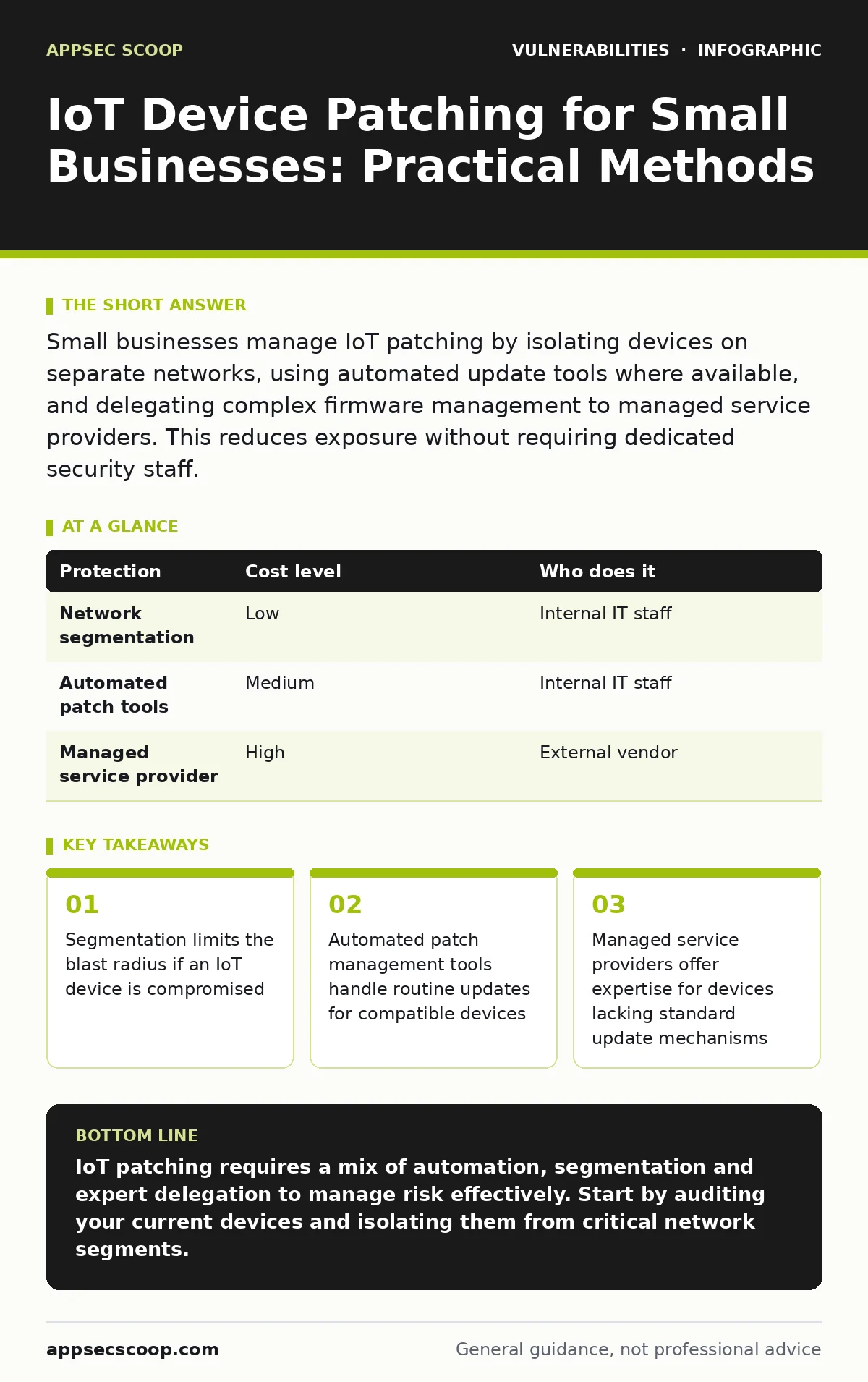
Small businesses manage IoT patching by isolating devices on separate networks, using automated update tools where available, and delegating complex firmware management to managed service providers. This reduces exposure without requiring dedicated security staff.
Why IoT Patching Matters at Small Scale
Small organisations often assume their size makes them invisible to attackers. This assumption is incorrect. IoT devices frequently run outdated firmware with known vulnerabilities. Attackers scan for these weaknesses regardless of the target's revenue or headcount. A single compromised device can serve as an entry point into the wider network. Once inside, an attacker can move laterally to access sensitive data or disrupt operations. The cost of downtime often exceeds the cost of proper patching. Small teams lack the bandwidth to manually check every device. This creates a structural weakness that automated systems can exploit. The risk accumulates silently until a breach occurs.
| Protection | Cost level | Who does it |
|---|---|---|
| Network segmentation | Low | Internal IT staff |
| Automated patch tools | Medium | Internal IT staff |
| Managed service provider | High | External vendor |
The Hidden Complexity of Firmware Updates
Firmware differs from operating system software. It resides in non-volatile memory and controls hardware functions. Updating firmware carries a higher risk of failure. A interrupted update can brick the device, rendering it unusable. Small businesses often avoid updates to prevent this downtime. This avoidance creates a security gap. Manufacturers sometimes discontinue support for older models. When support ends, vulnerabilities remain unpatched indefinitely. You must verify whether a device receives regular security updates. If a manufacturer stops issuing patches, the device becomes a permanent liability. Consider replacing such devices before a vulnerability is exploited.
Affordable Ways to Manage Updates
Manual patching is inefficient and error-prone. Small teams should prioritise automation. Many modern IoT devices support over-the-air updates. Configure these devices to update automatically during off-hours. This ensures patches apply without manual intervention. For devices that do not support automatic updates, schedule regular maintenance windows. Use a centralised dashboard if available. This provides visibility into update status across all devices. If no dashboard exists, maintain a manual inventory. Record the firmware version and last update date for each device. This simple practice helps identify devices that have fallen behind.
What to Delegate to Experts
Some IoT devices require specialised knowledge to patch safely. Industrial controllers, medical devices or complex surveillance systems fall into this category. Attempting to patch these devices without expertise can cause catastrophic failures. In such cases, delegate the task to a managed service provider. These providers have the tools and experience to handle complex updates.
They also monitor for emerging vulnerabilities and apply patches promptly. This shifts the burden of maintenance away from your internal team. You retain oversight while leveraging external expertise. Ensure the provider follows strict change management procedures. This prevents unintended service interruptions during the patching process.
Segmentation as a Safety Net
Patching cannot always keep pace with new vulnerabilities. Segmentation provides a critical layer of defence. Place IoT devices on a separate network segment. This isolates them from critical business systems. If an IoT device is compromised, the attacker cannot easily access other parts of the network. Use firewall rules to restrict traffic between segments. Allow only necessary communications. For example, a smart thermostat should not need access to the finance server. This principle of least privilege reduces the attack surface. Segmentation does not replace patching, but it mitigates the impact of a failure to patch. It buys time while you address the vulnerability.
See also: Exploitability versus Severity: How to Prioritise Real Risk
Questions to Ask an IT Provider
When delegating IoT patching, clarity is vital. Ask your provider specific questions to ensure adequate coverage.
- How do you track firmware versions across diverse IoT devices?
- What is your procedure for testing patches before deployment?
- How do you handle devices that no longer receive manufacturer updates?
- Can you provide regular reports on patch compliance?
- What is your response time for critical vulnerabilities?
These questions help you assess the provider's capability. They also establish clear expectations. A competent provider will have documented processes for each scenario. They should also offer guidance on device lifecycle management. This includes recommendations for replacing obsolete hardware. Regular communication ensures alignment between your security goals and their operational practices.
Balancing Security and Usability
Over-aggressive patching can disrupt business operations. Devices may reboot unexpectedly or lose configuration settings. This creates friction for staff who rely on these tools. Find a balance between security and usability. Test patches in a non-production environment first. This identifies potential issues before they affect users. Communicate scheduled maintenance windows clearly. This prepares staff for temporary disruptions. Educate users on the importance of patching. When staff understand the risks, they are more likely to cooperate. This cultural shift supports long-term security hygiene. It reduces resistance to necessary changes.
Long-Term Strategy for IoT Security
Patching is an ongoing process, not a one-time fix. New vulnerabilities emerge regularly. Your strategy must adapt to this reality. Regularly review your IoT inventory. Remove devices that are no longer necessary. Replace devices that are end-of-life. Invest in devices with strong security features. Look for hardware that supports secure boot and encrypted communications. These features reduce the risk of tampering. Engage with manufacturers to stay informed about security issues. Participate in industry forums or newsletters. This proactive approach helps you stay ahead of emerging threats. It also demonstrates a commitment to security best practices.
Integrating with Broader Security Practices
IoT patching does not exist in isolation. It must align with your overall security strategy. Ensure that patching processes integrate with incident response plans. Define clear roles and responsibilities. This ensures a coordinated response to security events. Regularly test your incident response procedures. Include IoT devices in these tests. This identifies gaps in your preparedness.
Review access controls regularly. Ensure that only authorised personnel can manage IoT devices. This reduces the risk of insider threats. Combine patching with other security measures. For example, use multi-factor authentication for administrative access. This adds an additional layer of protection. A holistic approach strengthens your defence posture.
For further reading on vulnerability assessment, consider exploring exploitability versus severity to prioritise your patching efforts. Understanding remote code execution vulnerabilities helps you identify high-risk devices. Additionally, attack vectors in CVSS provide a framework for evaluating threats. These resources complement your patching strategy by providing context for risk management.
Key takeaways
- Segmentation limits the blast radius if an IoT device is compromised
- Automated patch management tools handle routine updates for compatible devices
- Managed service providers offer expertise for devices lacking standard update mechanisms
IoT patching requires a mix of automation, segmentation and expert delegation to manage risk effectively. Start by auditing your current devices and isolating them from critical network segments.
Frequently asked questions
How often should I patch IoT devices?
Patch IoT devices as soon as security updates become available. Critical vulnerabilities should be addressed immediately, while routine updates can follow a scheduled maintenance window. Regular monitoring ensures timely application of patches.
What if my IoT device has no update option?
If a device lacks update capability, isolate it on a separate network segment. Limit its access to essential services only. Consider replacing the device if it poses a significant security risk. Manufacturers may offer firmware flashes via manual methods, but this carries risks.
Can I automate patching for all IoT devices?
Not all IoT devices support automated patching. Check manufacturer documentation for supported methods. For devices that do not support automation, use manual processes with strict scheduling. Managed service providers can help automate updates for compatible devices.
How do I know if a patch is safe?
Review release notes from the manufacturer for known issues. Test patches in a controlled environment before deployment. Verify that the patch does not break critical functionality. Consult with your IT provider or vendor for guidance on potential risks.
How this guide was produced: written by the AppSec Scoop editorial team with AI assistance, checked against the public references listed below, and reviewed when the facts change. See our editorial policy or report an error.