
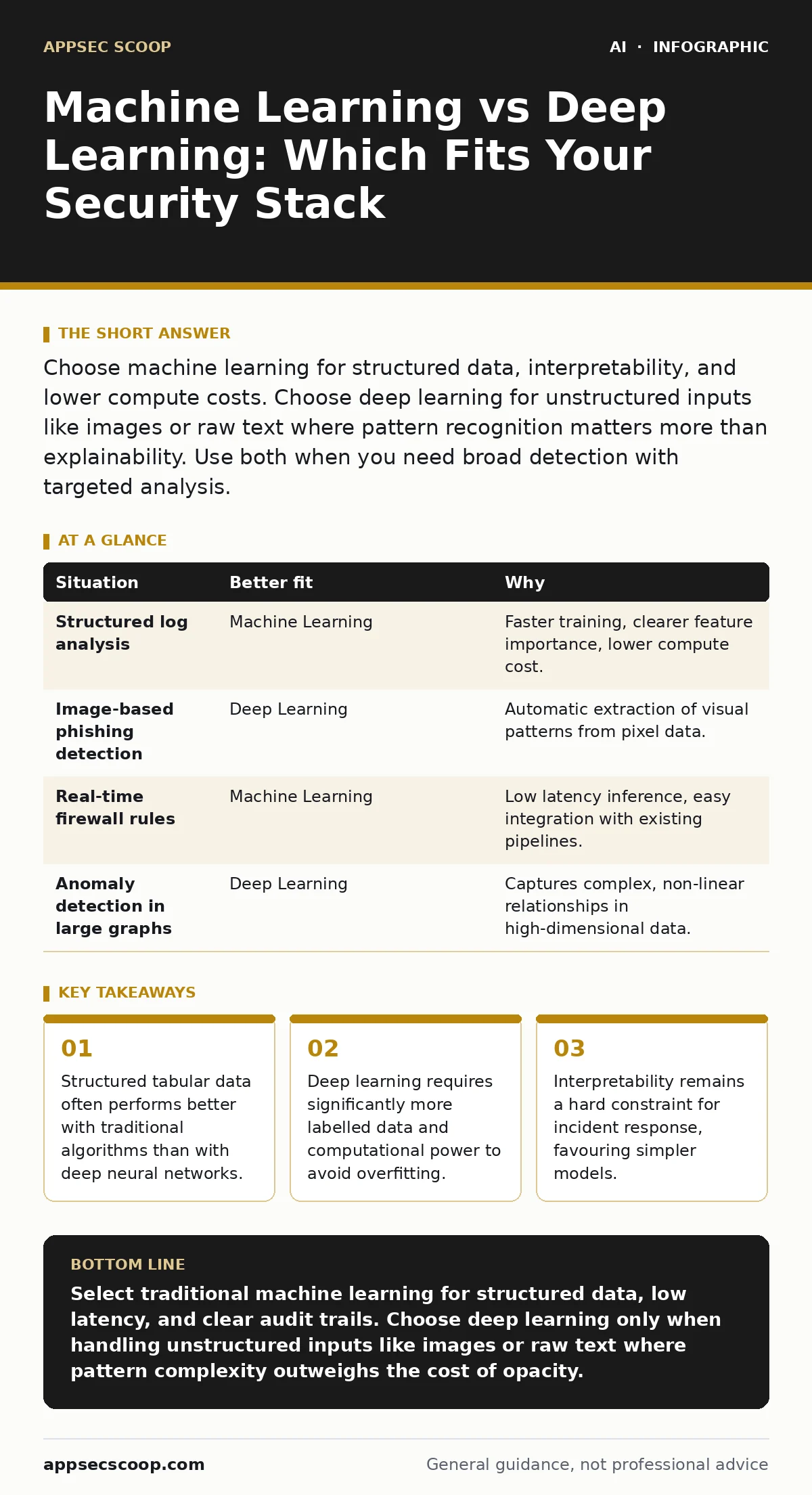
Choose machine learning for structured data, interpretability, and lower compute costs. Choose deep learning for unstructured inputs like images or raw text where pattern recognition matters more than explainability. Use both when you need broad detection with targeted analysis.
Data Structure and Input Type
The nature of your input data dictates the architecture you must build. Traditional machine learning algorithms thrive on structured data. This includes rows and columns of numerical values, categorical labels, or time-series logs. Algorithms like random forests or gradient boosting trees process these inputs efficiently. They calculate feature importance explicitly, allowing you to see which variables drive the prediction.
Deep learning relies on neural networks with many hidden layers. These networks excel at unstructured data. This includes pixel arrays from screenshots, raw text from logs, or audio waveforms. The network learns hierarchical representations automatically. It does not require manual feature engineering. If your input is a spreadsheet of IP addresses and ports, deep learning adds unnecessary complexity. If your input is a screenshot of a phishing email, deep learning extracts visual patterns that rule-based systems miss.
The Interpretability Requirement
Security operations require trust in automated decisions. When a model flags an alert, analysts need to know why. Traditional machine learning models offer inherent interpretability. You can inspect the decision boundaries. You can see which features contributed to a specific classification. This transparency aids in root cause analysis. It helps engineers refine rules when false positives occur.
Deep learning models operate as black boxes. The internal weights are distributed across millions of parameters. Explaining a specific decision requires additional techniques like SHAP or LIME. These methods approximate the model's behaviour but do not provide direct insight into the logic. In high-stakes environments, this opacity creates friction. You may struggle to justify blocking a legitimate user based on an opaque probability score. If your compliance framework demands clear audit trails of decision logic, traditional algorithms are the safer choice.
Computational Resources and Latency
Training and inference costs differ significantly between the two approaches. Traditional machine learning models are lightweight. They train quickly on standard hardware. Inference happens in milliseconds. This speed matters for real-time threat detection. You can deploy these models on edge devices or within high-throughput log pipelines. The resource footprint is minimal.
Deep learning models are computationally expensive. Training requires powerful GPUs or TPUs. It consumes significant energy and time. Inference also demands more memory and processing power. If you need to analyse millions of events per second, deploying a large neural network may introduce unacceptable latency. The trade-off is accuracy versus speed. Deep learning may catch subtle anomalies, but it cannot always keep up with real-time data streams.
Data Volume and Labelling Effort
Deep learning is data-hungry. It requires vast quantities of labelled examples to generalise effectively. Without enough data, the network memorises the training set. This is called overfitting. The model fails on new, unseen threats. Labelling data is labour-intensive. You need security experts to tag logs or images as benign or malicious. This process slows down development cycles.
Traditional machine learning works well with smaller datasets. Algorithms like support vector machines or decision trees converge with fewer examples. They are less prone to overfitting on limited data. If you cannot gather millions of labelled samples, traditional methods provide a more stable baseline. They allow you to deploy useful models while you accumulate more data.
| Situation | Better fit | Why |
|---|---|---|
| Structured log analysis | Machine Learning | Faster training, clearer feature importance, lower compute cost. |
| Image-based phishing detection | Deep Learning | Automatic extraction of visual patterns from pixel data. |
| Real-time firewall rules | Machine Learning | Low latency inference, easy integration with existing pipelines. |
| Anomaly detection in large graphs | Deep Learning | Captures complex, non-linear relationships in high-dimensional data. |
See also: Training Data Leakage Explained: How AI Memorises Your Secrets · AI versus Machine Learning: Which Technology Fits Your Security Needs?
Combining Both Approaches
You do not always have to choose one. Hybrid architectures leverage the strengths of both. Use deep learning for feature extraction on unstructured data. Pass these extracted features into a traditional classifier. This combines pattern recognition with interpretability. For example, a neural network can summarise a complex log sequence into a vector. A random forest classifier then decides if the vector represents an attack. This approach reduces the black-box nature of the final decision.
Another pattern involves cascading filters. Use a fast, traditional model to filter out obvious benign traffic. Only send suspicious items to the heavier deep learning model. This reduces compute costs. It ensures that the expensive model focuses on ambiguous cases. This strategy balances accuracy and efficiency. It allows you to scale detection without overwhelming your infrastructure.
Key takeaways
- Structured tabular data often performs better with traditional algorithms than with deep neural networks.
- Deep learning requires significantly more labelled data and computational power to avoid overfitting.
- Interpretability remains a hard constraint for incident response, favouring simpler models.
Select traditional machine learning for structured data, low latency, and clear audit trails. Choose deep learning only when handling unstructured inputs like images or raw text where pattern complexity outweighs the cost of opacity.
Frequently asked questions
Can deep learning replace traditional machine learning entirely?
No. Traditional algorithms remain more efficient and interpretable for structured data. Deep learning adds complexity that often provides no benefit for simple classification tasks.
How do I know if I have enough data for deep learning?
If your model performs well on training data but poorly on new data, you likely lack sufficient volume. Traditional models usually stabilise with fewer examples.
Is deep learning harder to maintain?
Yes. Neural networks require continuous retraining and monitoring for concept drift. They are more sensitive to data distribution changes than simpler statistical models.
What if I need real-time detection with unstructured data?
Consider using a smaller, optimised neural network or a hybrid approach. Extract features with deep learning offline, then use a fast traditional model for real-time inference.
How this guide was produced: written by the AppSec Scoop editorial team with AI assistance, checked against the public references listed below, and reviewed when the facts change. See our editorial policy or report an error.