Verify the caller’s identity through a separate, pre-arranged channel. Listen for missing breath sounds, robotic pauses, and inconsistent emotional tone. Do not transfer funds or share credentials based on voice alone. Use out-of-band verification to confirm the source before acting on any urgent request.
The Uncanny Valley of Audio
Voice cloning technology creates synthetic speech by analysing short audio samples. These samples allow the model to mimic pitch, accent, and cadence. The result is audio that sounds convincing to the untrained ear. However, current models struggle with the subtle biological noise of human speech. This gap between synthetic perfection and human reality creates detectable artefacts.
Immediate Auditory Signals
The first signs of a cloned voice are often auditory inconsistencies. Listen for the absence of natural breathing. Human speech requires air intake, especially during long sentences or emotional distress. Cloned audio often removes these pauses to maintain flow. You may also notice a lack of micro-expressions in the voice. These are tiny shifts in tone that occur when a person thinks or reacts. Synthetic voices often remain static in emotional register.
Another immediate signal is the quality of the background noise. Real calls contain ambient sound that changes as the speaker moves. Synthetic audio often has a static or artificially generated background. This background may loop or remain unnaturally constant. If the caller claims to be in a noisy environment but the audio remains clean, treat this as a warning.
Subtle Linguistic Failures
More advanced cloning tools can mimic breathing and background noise. These tools require you to listen for linguistic failures instead. Voice models are trained on existing data and struggle with novel contexts. They may hesitate or produce gibberish when asked to repeat a phrase with different emphasis. This happens because the model predicts the next word rather than understanding the intent.
Imagine a caller asking for urgent financial help. If you ask them to spell a complex word or describe their current surroundings in detail, the model may falter. It lacks the real-time cognitive processing required for spontaneous elaboration. The voice may sound clear, but the content will lack coherence. This disconnect between vocal clarity and cognitive depth is a key indicator.
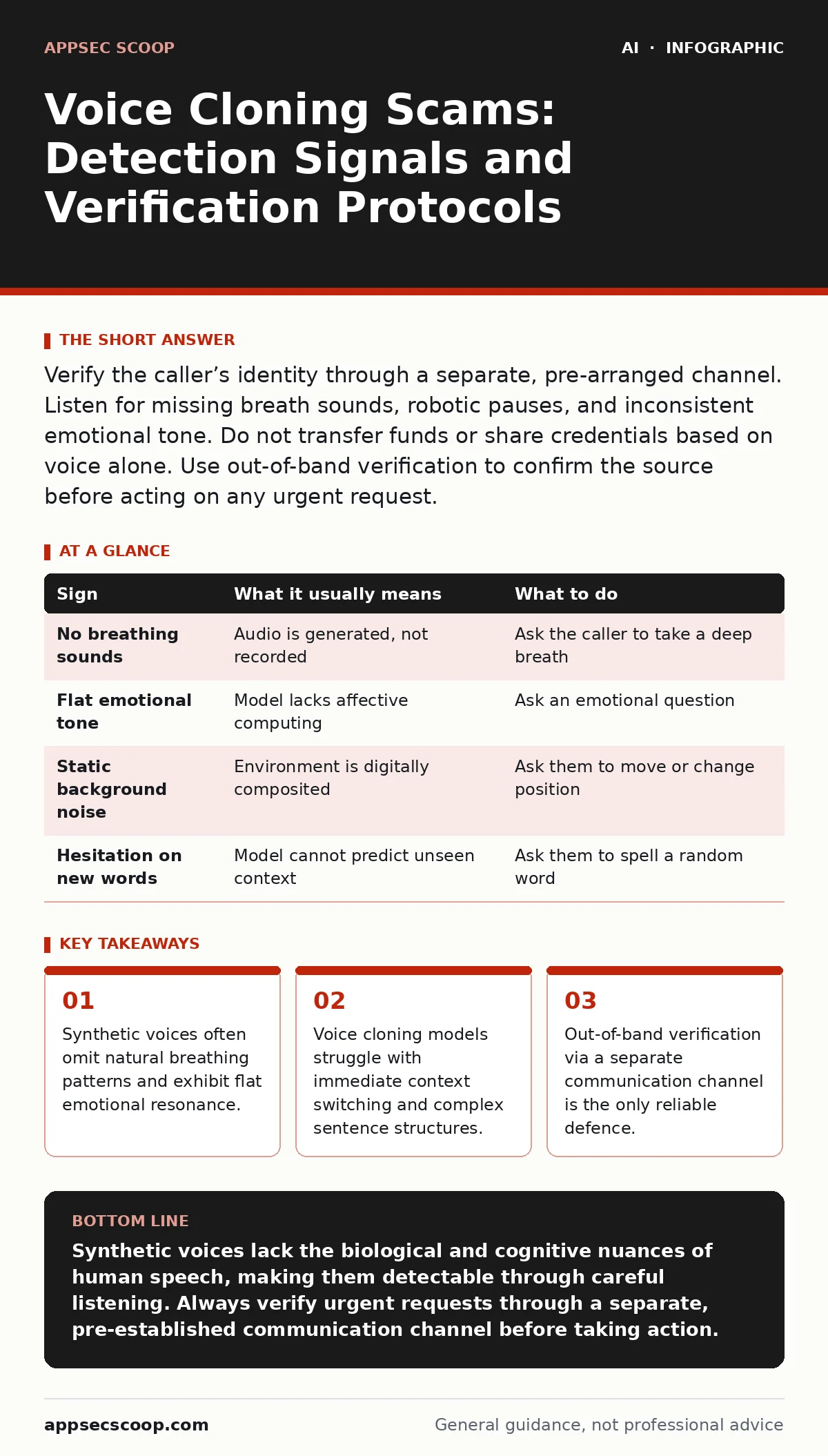
| Sign | What it usually means | What to do |
|---|---|---|
| No breathing sounds | Audio is generated, not recorded | Ask the caller to take a deep breath |
| Flat emotional tone | Model lacks affective computing | Ask an emotional question |
| Static background noise | Environment is digitally composited | Ask them to move or change position |
| Hesitation on new words | Model cannot predict unseen context | Ask them to spell a random word |
The Context Switch Trap
Voice cloning models excel at continuing a pattern. They fail when the pattern breaks. This is known as the context switch trap. If the conversation shifts abruptly from casual chat to a high-stakes request, the model may not adapt its tone. It may maintain a calm, neutral voice even when discussing an emergency. Humans naturally raise their pitch or speed under stress. A cloned voice often remains eerily calm.
This inconsistency arises because the model is optimised for fluency, not situational awareness. It does not understand the gravity of the situation. It only predicts the next likely sound. You can exploit this by changing the subject unexpectedly. Ask a question that requires lateral thinking. The model’s inability to handle this shift reveals its artificial nature.
Verification Beyond the Voice
Relying on audio analysis alone is insufficient. Determined attackers use increasingly sophisticated models. These models can mimic breathing and emotional shifts. The only reliable defence is out-of-band verification. This means confirming the caller’s identity through a different channel. Use a phone number you already have on file, not one provided by the caller.
Do not use social media or email for this verification. These channels are often compromised. Use a pre-arranged code word or phrase. This phrase should be known only to you and the person you are verifying. It adds a layer of authentication that a cloned voice cannot replicate. This method is discussed in detail in our guide on deepfake fraud.
Operationalising Detection
Security teams must integrate voice verification into their protocols. Treat voice as an untrusted input. Assume any incoming call could be synthetic. Implement a policy that requires secondary verification for any request involving funds or sensitive data. This aligns with the principles in the NIST AI Risk Management Framework.
Training staff to recognise these signs is also necessary. Regular simulations can help teams identify the subtle cues of synthetic audio. These simulations should include high-pressure scenarios. This prepares staff to maintain composure and follow verification steps. For broader context on automated threats, see our guide on AI agents.
The Hidden Cost of Trust
The real danger of voice cloning is not just financial loss. It is the erosion of trust in remote communication. When people cannot trust their ears, they may delay critical actions. This hesitation can have operational consequences. Organisations must balance security with efficiency. Overly strict verification can slow down legitimate processes.
Finding the right balance requires clear policies. Define which actions require strict verification. Keep routine communications open but monitored. This approach minimises friction while maintaining security. Understanding the trade-offs is key to effective implementation. For more on managing these risks, refer to our guide on AI transparency.
Key takeaways
- Synthetic voices often omit natural breathing patterns and exhibit flat emotional resonance.
- Voice cloning models struggle with immediate context switching and complex sentence structures.
- Out-of-band verification via a separate communication channel is the only reliable defence.
Synthetic voices lack the biological and cognitive nuances of human speech, making them detectable through careful listening. Always verify urgent requests through a separate, pre-established communication channel before taking action.
Frequently asked questions
Can voice cloning bypass two-factor authentication?
If the second factor is voice-based, yes. Cloned voices can mimic the required phrase. Use app-based or hardware tokens instead of voice verification.
How much audio is needed to clone a voice?
Modern models can create convincing clones with just a few seconds of audio. Short clips from social media are often sufficient for basic imitation.
Is there software to detect cloned voices?
Detection tools exist but are not foolproof. They often produce false positives. Human verification remains the most reliable method for critical decisions.
Does voice cloning work on video calls?
Yes. Real-time voice cloning can replace the audio stream in video calls. Look for lip-sync mismatches and audio artefacts in these scenarios.
How this guide was produced: written by the AppSec Scoop editorial team with AI assistance, checked against the public references listed below, and reviewed when the facts change. See our editorial policy or report an error.